Three InCubed satellites have launched from the Vandenberg Space Force Base, California, highlighting ESA’s role as partner to industry and its support for business and technology innovation.
InCubed, the ESA Earth observation programme for ‘Investing in Industrial Innovation’ managed by ɸ-lab, focuses on developing innovative and commercially viable products and services that generate or exploit the value of Earth observation imagery and datasets.
The launch took place on 14 January on a SpaceX Falcon 9, Transporter 12, which placed multiple small and nano satellites into Sun-synchronous orbits.
With the launch site approximately 200 km to the North-West of the wildfires that have caused huge damage to northern areas of Los Angeles in the past week, it’s apt that one of the InCubed satellites offers improved detection for wildfires.
Supported by the ESA InCubed programme, the Portuguese Space Agency has announced a call for innovative projects to modernise Portuguese cities through the use of Earth Observation (EO) technologies. This InCubed call has a total budget of €1.5 million. The deadlines for the first and second cycle of applications are 12 March and 2 June 2025, respectively.
The ESA InCubed programme plays an important role in growth and competitiveness within the space economies of its Participating States by supporting the development of commercially successful business ventures in the Earth Observation sector. As a longstanding participant in InCubed, Portugal has reaffirmed its commitment by announcing a new call for applications seeking InCubed co-funding.
Building on the ‘EO for Municipalities’ initiative by the Portuguese Space Agency, this new call promotes innovation and the adoption or generation of EO data and services at the local government level, targeting participation from the Portuguese industry.
Possible themes include, but are not limited to, territory and urban planning; climate adaptation and mitigation in urban and rural context; air quality and pollution monitoring; biodiversity monitoring and preservation; forestry management and fire preparedness; natural hazards monitoring and emergency management. The budget for this call is €1.5 million, with no upper limit for individual projects.
Submitted proposals must demonstrate that the proposed product or service will be commercially viable or (pre)operationally ready by the conclusion of the InCubed activity, and they should align with the technical specifications for systems integration outlined by the Agency for Administrative Modernisation, I.P. (AMA), under the framework of the National Strategy for Intelligent Territories (ENTI).
Proposals can be submitted at any time, with two evaluation cycles per year. The first evaluation cycle is scheduled for March 2025 and the second one for June 2025. Two online webinars to explain InCubed opportunities in Portugal will take place on 3 March 2025 and 5 May 2025.
“Launching targeted national calls allows us to collaborate closely with our Participating States to drive Earth Observation innovation within individual countries, and the ‘EO for Municipalities’ initiative from Portugal highlights the strong dedication to support commercial initiatives”, commented Michele Castorina, InCubed Programme Manager and Head of the ESA Φ-lab Invest Office. “We are committed to working closely with our Participating States to expand financing opportunities for Europe’s EO sector, and we look forward to receiving innovative proposals from Portuguese companies.”
ESA has signed a letter of intent with Altair to encourage the development of Earth observation (EO) commercial products and services. The collaboration will target companies supported by ESA Φ-lab, the InCubed EO commercialisation programme, ESA-PhiLabNET, ESA Business Incubation Centres (ESA BICs) and ESA Technology Brokers, within the ESA Partnership Initiative for Commercialisation (EPIC) framework.
ESA Φ-lab plays a pivotal role in driving innovation and commercialisation in the European EO sector, by providing technical, commercial and financial support to a large group of enterprises through the ESA InCubed programme and other numerous research initiatives. Its contributions go beyond funding and guidance, extending to the formation of strategic partnerships that offer essential business and commercialisation services.
One of such partnerships, established through the ESA Partnership Initiative for Commercialisation (EPIC), was secured with the German division of Altair, which provides software and cloud solutions in simulation, high-performance computing (HPC), data analytics, and AI, and has decades of global experience and reach in the space and newspace sector. Altair is used by primary companies and emerging startups to develop, test, optimise, and build their innovative products, including satellites, launchers, sensors and antennas, probes and rovers.
The partnership between Φ-lab and Altair, within the ESA-Altair Space Acceleration Programme, is focused on the development of a dynamic and thriving EO commercial ecosystem, by making use of digital engineering, AI and data analytics tools, and increasing awareness of EO-based services.
“This collaboration with Altair marks a significant milestone in our mission to push the boundaries of Earth observation exploration and technological development”, comments Giuseppe Borghi, Head of the Φ-lab division. “Together, we aim to leverage the use of HPC and data analytics for the advancement of groundbreaking projects, creating new possibilities within the space research field and enhancing Europe’s position as a leader in Earth observation innovation.”
Further details about this partnership and the two offers for start-ups and large companies provided within the Φ-lab-Altair partnership can be found here.
The Earth observation (EO) domain is undergoing a disruptive transformation featuring onboard intelligence and innovative sensing capabilities. With the support of InCubed, ESA EOP co-funding programme led by Φ-lab, IngeniArs is implementing EO MakerSpace – an initiative dedicated to AI on edge for the development of EO smart sensors.
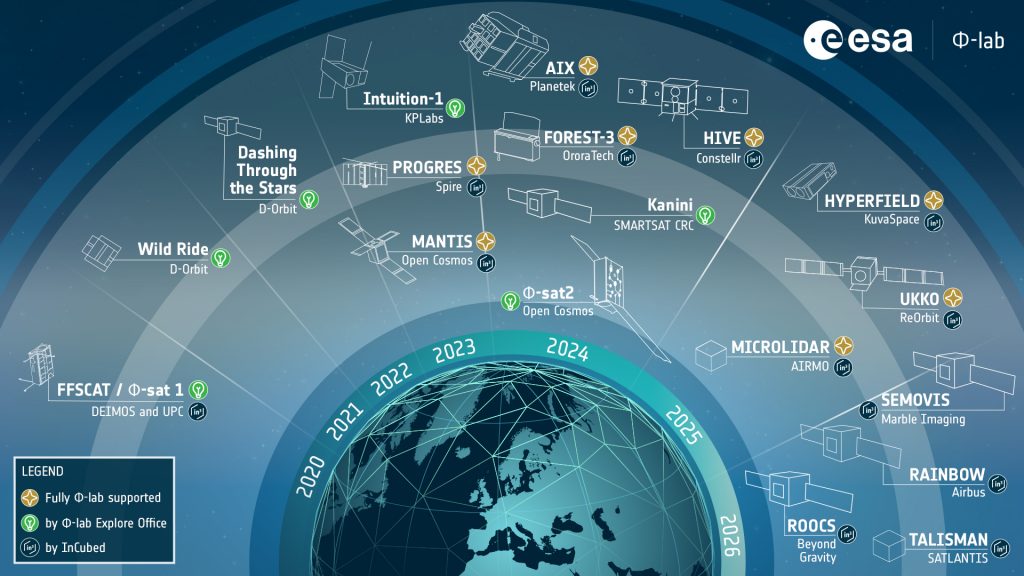
The space sector is currently experiencing a technological and business evolution driven by increased demand and specialised advancements, such as onboard intelligence. Through the use of advanced AI techniques to process information directly on spacecraft, onboard intelligence promises to deliver more efficient, agile, autonomous, and reconfigurable Earth observation (EO) systems. ESA Φ-lab has a track record of developments in this area, as depicted below.
Timeline of Φ-lab-powered satellites and constellations
The latest research efforts have been committed to exploring the use of AI on edge for EO applications, such as the early detection of natural disasters, vessel incidents, and gas leaks. Onboard intelligence is also capable of identifying low-quality data, like cloud-covered satellite data and remote sensing images with limited information of interest, discarding them to save downlink data bandwidth to the ground station.
Leveraging the full capabilities of AI on edge in EO systems needs the development or enhancement of both space-related software and hardware. These improvements are essential for seamless integration with innovative sensors, as well as for preprocessing, calibrating, and correcting sensory data to guarantee the accurate performance of AI algorithms. To cope with the limited power and energy budget in space, it is essential for hardware and software design to work in tandem to maximise energy efficiency.
To achieve these goals and with a focus on the Italian ecosystem, ESA InCubed is partnering up with IngeniArs, a company specialised in the development of innovative high-tech electronic and informatics systems, in the aerospace, healthcare, cybersecurity and AI domains. IngeniArs has been developing GPU@SAT, a hardware/software ecosystem for space systems dedicated to AI and Computer Vision applications.
This contract is focused on the rapid and responsive prototyping of core elements of smart EO payloads within the GPU@SAT ecosystem, based on joint software and hardware developments. IngeniArs will coordinate the elements of individual (sub-)activities, while ESA InCubed will oversee and expedite the approval process. IngeniArs will be responsible for managing each (sub-)activity development with suitable entities.
Italian individuals, start-ups, SMEs, LSIs, university spin-offs and any innovative entities are welcome to apply and participate in the development of EO payloads.
Activities can be developed within the following domains: algorithm optimisation and software abstraction, sensor selection and integration, onboard data compression, smart sensor management and AI-based autonomous navigation. To facilitate the development of these activities, the GPU@SAT ecosystem will be implemented on a representative device, creating a dedicated development kit – the GPU@SAT devkit. To know more about these activities and to apply, visit the dedicated IngeniArs project webpage.
Giuseppe Gentile, CEO of IngeniArs, comments: “At IngeniArs we are very proud of leading this project. It will be a very important moment to gather the Italian ecosystem around the hot topic of ‘enabling Artificial Intelligence on-board’. We will make our GPU@SAT platform available for the development of applications and modules within a fully representative space environment, and we are very excited to see the results.”
This initiative will offer the EO ecosystem a report with the overall findings, including improved mechanisms to spur innovation and possible demonstrations or pilots, followed by a technological roadmap with the remaining open questions and technical gaps.
“The integration of AI algorithms with specialised hardware and software co-design can accelerate the future of Earth observation missions, leading to substantial reductions in time, costs, and the need for human resources while improving performances, latency time, and missions’ autonomy” comments Michele Castorina, Head of the Φ-lab Invest Office. “This collaboration with IngeniArs aligns with the InCubed mission to foster innovative technologies in the space industry, improving the efficiency and agility of autonomous EO systems through cutting-edge AI techniques.”
Taking place at KAP Europa in Frankfurt, Germany, from 27 to 28 November 2024, the second ESA Earth Observation Commercialisation Forum will bring together stakeholders from the Earth observation and space commercialisation sectors, including end users, space industry players, entrepreneurs, private and public investors and policymakers to discuss and promote commercial opportunities in Earth observation.
The event is an important part of ESA’s broader strategy to enhance the economic return from Earth observation investments to ensure that space technology contributes to sustainable economic growth.
The ESA Earth Observation Commercialisation Forum (ESA CommEO) is a collaborative initiative by ESA’s Earth Observation Programme along with the Commercialisation, Industry and Competitiveness directorate to foster the commercialisation of Earth observation space technologies and services.
To support the growth of space-related businesses and startups, ESA CommEO features dedicated events, workshops and networking opportunities to connect different stakeholders, providing information and insights on market trends, showcasing success stories and innovative solutions and offering platforms for pitching ideas and business plans to potential investors.
Spain-based companies of any size are invited to participate in the latest Φ-lab InCubed co-funding call, by submitting proposals for the development of groundbreaking and commercially successful products in the Earth observation (EO) field. The call opens on 15 September and the deadline for submissions is 28 October 2024 at 14:00 CET.
InCubed is an ESA co-funding partnership programme run by ESA Φ-lab that aims to fill the gap between business ideas and the Earth observation market, with the support of its signatory Participating States. Focusing on leveraging the benefits of EO data and services, InCubed provides co-funding for the development of any elements of the EO value chain, namely full satellites and constellations, platforms, payloads and instruments, ground segment-based systems, and downstream applications and value-added services.
Entities can apply for different levels of co-funding, depending on the type of activity, and will be guided by ESA top-tier experts to create sound products/services from a technical, commercial, and financial standpoint. In this partnership, ESA will act as the partner of the proposing company, with the aim to reduce its development and business risks.
In collaboration with the Spanish Space Agency (AEE), this latest call will open on 15 September 2024 and has a budget of €11 million, of which up to 30% can be allocated to de-risking activities (see its definition here). Proposals should be focused in developing EO innovative and commercially successful products and services. Proposals for Contract Change Notices for ongoing InCubed contracts may be submitted as well and will follow the same evaluation criteria of the new proposals.
Proposals may include non-Spanish suppliers, as long as they are essential for the success of the project. The goal is to demonstrate a strong economical return to the Spanish space sector, including both the lead applicant and their partners and supply chains. Proposed activities may be funded up to 50% of the total cost in the Product Development Cycle, and up to 75% in the De-risking Cycle. Universities and research institutes with no commercial interest in the project may be funded up to 100% of their costs if those do not surpass 30% of the total activity funding. Ideas currently being funded by other ESA/AEE programmes are not eligible for this call.
Differing from previous standard procedures, this specific call will not require pitch presentations from applicants. Spanish companies must submit directly an Outline Proposal (Part 1) on the dedicated InCubed platform, which will be ranked based on defined criteria. Those who score above the cut-off point will be invited to submit a full proposal to ESA, together with the letter of support from AEE, which they must do within 4 to 6 weeks after the invitation. Successful applicants identified by the Tender Evaluation Board will be contacted directly by ESA to discuss further contract negotiations.
Interested entities can find out more about this call during the AEE event in Madrid, on 3 September, and enrol via the AEE dedicated link. The call opens on 15 September and theclosing date for submissions is 28 October 2024 at 14:00 CET.
InCubed, a co-funding programme managed by ESA Φ-lab, is supporting agriKOPA – a platform that provides financial services and real-time crop monitoring, being an easy and convenient tool for end users during the agricultural season. This platform is led by agriBORA, a Kenyan-German agri-fin-tech company that aspires to empower small farming businesses in Africa.
ESA InCubed, an ESA EOP co-funding programme managed by Φ-lab, has a proven reputation for establishing contracts to develop pioneering technologies, services, and applications within the Earth observation (EO) domain. Φ-lab and the World Food Programme Innovation Accelerator set up the EO & AI for SDGs Innovation Initiative in 2021 to find commercially viable EO and AI-based solutions to counteract global hunger issues. As a result of the selection process, agriBORA, a Kenyan-German agri-fin-tech company that strives to transform the agricultural business model in African countries, received a grant to demonstrate a proof of concept within the initiative’s theme. AgriBORA further matured its solutions and was then selected for a contract in the context of an InCubed funding call.
Agriculture is a key point for food security in Kenya, and it also provides a source of income. Climate change endangers crop development, which puts the farmers’ way of living at risk. With the support of InCubed, agriBORA is developing agriKOPA, an initiative that relies on the use of data analytics powered by EO satellite data, enabling local agri-merchants to work with agriHUBs – providers that offer climate-smart advisory services, linking financial services, input suppliers, farmers, and the market. The novelty in the use of EO data by agriKOPA is the creation of a score for each farmer, enabling Financial Service Providers (FSPs) to lend credit with more confidence. The loans will then allow farmers to purchase the inputs needed for production.
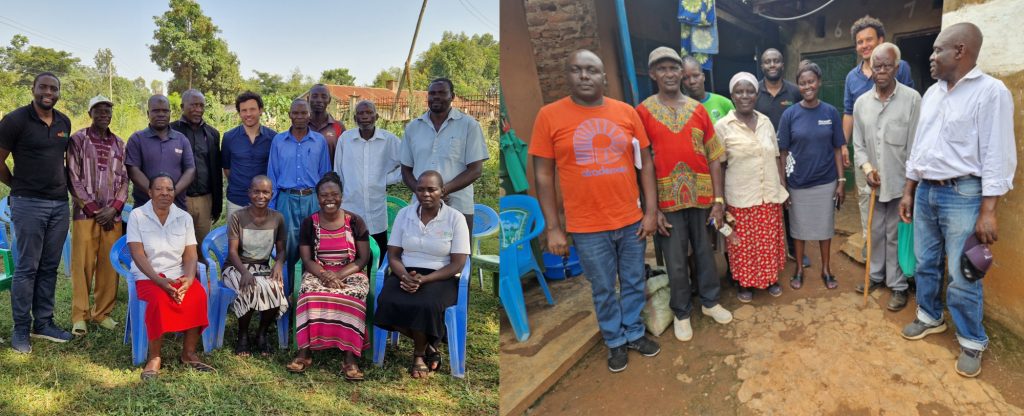
Albin Lacroix, a Φ-lab InCubed officer, shared his thoughts on the latest mission in Kenya, from 10 to 12 June 2024. This mission included visits and meetings with different stakeholders – agriBORA, Kenya Commercial Bank, and the Kenyan Space Agency.
The mission started with a visit to the agriBORA premises, in Nairobi, focusing on one of the milestones of the project – the factory acceptance test (FAT). This represents the finalisation of the technical development of the service, and the kick-off of the pilot phase, rendering the service operational for test users. “Our meeting about FAT was particularly important for the project, as the service relies on many interactions between farmers, agriHUBs, loan providers, and agriBORA. Together with Kizito Odhiambo, Founder and CEO of agriBORA, and the Kenyan team members, we went through the intricate process pipeline of agriKOPA”, comments Albin.
The second day was spent on two different agriHUBs in Kisumu. The visits to these agriHUBs were the key point of the mission, given that there was direct contact between the InCubed programme, hub managers and farmers, who are the end users of the service. These meetings were held half in English, and half in Swahili, providing feedback on the first pilot tests conducted by agriBORA.
Albin Lacroix says “InCubed is a market-oriented programme and end users are the center of our solution design. Meeting them in person was very important. It was incredibly interesting to hear their daily concerns and the advantages they get from agriKOPA. The added value is immense, from getting good quality material inputs on time to ensuring loans and insurance in the case of bad crop years. The EO aspect is not directly visible to the farmers, but it is crucial for the estimation of the score provided by agriBORA to FSPs, allowing them to trust the smallholder they will lend credit to.” The next step will be the successful conduction of the pilot phase, followed by scaling up.
Albin Lacroix visits two agriHUBs in Kisumu
The third and final day of the mission began with a visit to the Kenya Commercial Bank (KCB) premises in Nairobi, and a meeting with a KCB representative. KCB is an FSP for agriBORA. After receiving requests for loans, agriBORA does a first round of scanning and filtering of applicants. KCB does a second round of scanning before releasing the loan to the farmer through the agriKOPA platform.
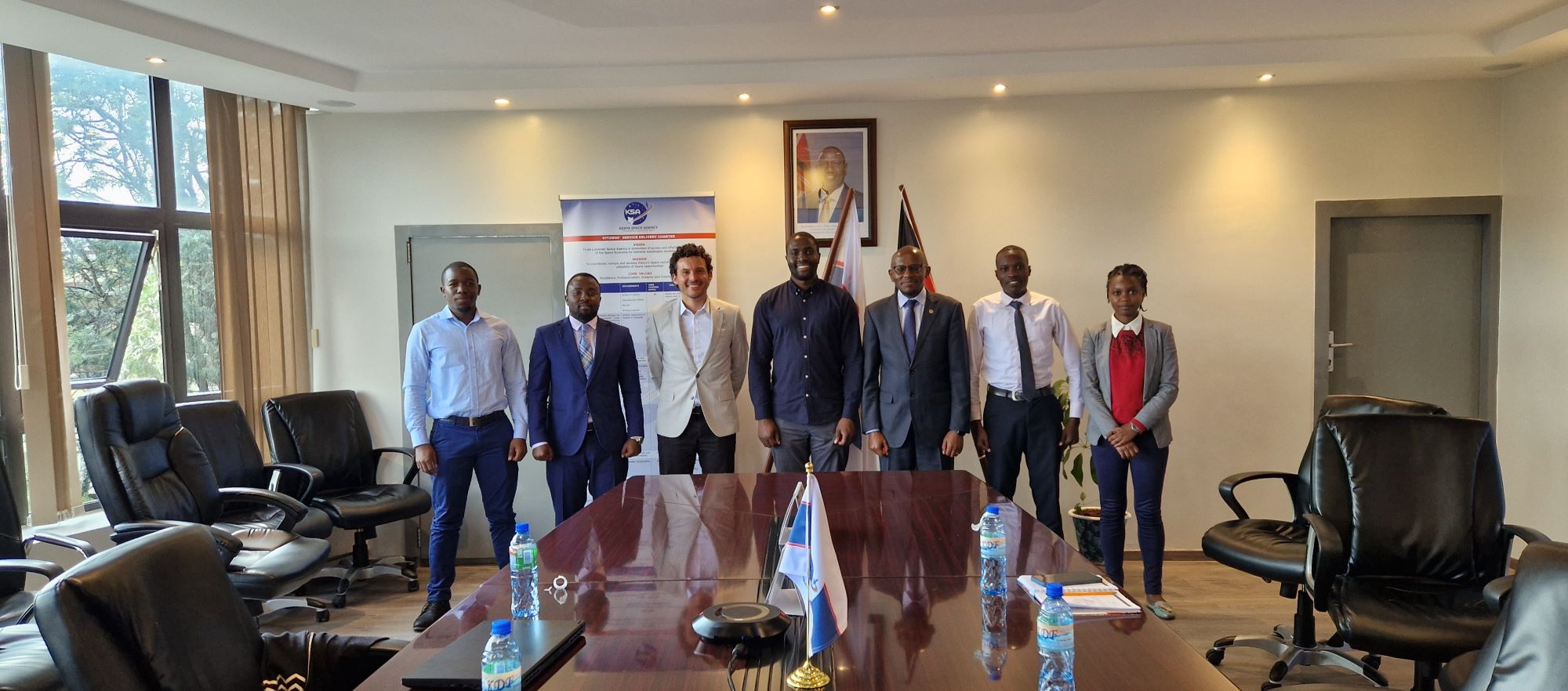
This was followed by a visit to the Kenya Space Agency (KSA). “The goal of the visit was for agriBORA to present their updates. KSA is very excited about this project, given that the topic of smallholder farmers is of great relevance to public authorities in Kenya. These farmers need funds to succeed in their activities and, with the support of InCubed, agriKOPA is the bridge between them and FSPs. KSA representatives also had the opportunity to get familiar with the work developed at Φ-lab and the main purpose of InCubed. Charles Mwangi, Head of the Earth Observation, Research, Education and Outreach Programmes at KSA was present in that meeting with three of his colleagues from KSA”, Albin remarks.
During this three-day mission, Albin Lacroix was accompanied by Kizito Odhiambo, Founder and CEO of agriBORA: “Unlocking access to finance through agriKOPA is a great milestone for us and aligns with our vision of making Africa the agricultural powerhouse of the world. The incredible support from ESA through InCubed and the strong partnerships with local financial service providers have been instrumental in the development phase, helping to de-risk the entire process. We are very excited to start the validation phase during the upcoming short rain season in August.”
Michele Castorina, Head of the Φ-lab Invest Office, comments: “this collaboration between InCubed and agriBORA has accelerated innovation in the EO, agriculture-related domain, providing agriBORA with cutting-edge satellite technology and expertise. Together, we are revolutionising farming, empowering smallholdings, and boosting productivity and sustainability. This is a leap towards a smarter, more resilient agricultural future.”
ESA and the UK Space Agency are pleased to announce a new joint funding call ‘InCubed2 – Innovation in Public Services with Satellite Earth Observation’ for all UK-based entities developing innovative and commercially viable Earth observation projects. The deadline for pitch proposal submissions is 12 September 2024.
InCubed is a co-funded programme run by ESA’s Φ-lab Invest Office, focusing on initiatives that exploit or enhance the value of Earth observation imaging and data. With the support of its participating Member States, InCubed funds a wide scope of activities, ranging from satellites to ground and downstream applications.
Successful applications receive personalised guidance from world-class experts to develop technical, commercial and financially viable products. Currently, 140 activities are in the pipeline and about 10 satellites are under development. One of these projects was launched in 2023 and three others are planned for launch in 2024.
In collaboration with the UK Space Agency (UKSA), the latest funding cycle will be open exclusively to the UK industry. Following the success of last year’s call, this round will be dedicated to activities with the underlying theme of ‘Innovation in public sectors use of Earth observation data’.
Following last year’s calls for proposals in the United Kingdom and Spain, seven new InCubed activities have now commenced. Addressing needs over the full range of the Earth observation value chain, the activities demonstrate how customer-oriented Earth observation solutions provide technological advances and tangible societal benefits.
With its co-funding of market-oriented development activities, the ESA InCubed programme is a key enabler for the financing of ventures that improve European competitiveness in Earth observation (EO). In cooperation with its participating Member States, InCubed periodically issues national calls in order to boost EO innovation and investment in specific countries.
InCubed national calls were launched in Spain and the UK last year. Both were met with an enthusiastic response, and InCubed then initiated a comprehensive evaluation process in conjunction with the space agencies of each country. The result so far is that five Spanish and two British companies have been awarded InCubed co-funding for new activities.
These activities cover both upstream and downstream applications, from instruments, data transmission and onboard software in the space segment to data processing and even an entire satellite mission. They respond to significant technical challenges, such as achieving timely intelligence extraction from Synthetic Aperture Radar (SAR) imagery, the need for higher resolution sensing in Thermal Infrared (TIR) cameras and the difficulty of reducing aerosol interference in methane detection.
Commercial EO España-style
The new activities from Spain encompass important developments in satellite technology. SATLANTIS’s TALISMAN is a 16U cubesat mission carrying a short-wave infrared (SWIR) optical instrument coupled with a liquid crystal polarimeter. The combination is designed to enable point-source methane detection – a vital activity for climate change mitigation – while minimising the impact of aerosol scattering. EODDL-LYNX from SENER builds on the company’s previous InCubed activity to integrate an active electronically steerable antenna with a payload data transmitter. The antenna will not only enhance downlink throughput and flexibility, but also provide a more compact, lightweight solution compared with mechanically steered variants.
Madrid-based Crisa will develop the power conditioning module of its NICE instrument control unit for satellites. The power conditioning module will complete the jigsaw of NICE’s core functions, alongside the payload controller and standard discrete interface module. Deimos Space’s Insight4EO picks up on the emerging trend of edge computing onboard satellites by providing a processing and intelligence services package for LEO EO missions. The activity is aimed at facilitating realtime decision-making, increased mission autonomy and higher data throughput.
In the downstream data processing segment, ATR4PAZ from Hisdesat will tackle the thorny issue of rapidly deriving meaningful insight from SAR data. Focusing on the security and intelligence sector, ATR4PAZ will simulate objects of interest on existing SAR imagery in order to train a machine learning to detect those features.
UK-side sustainability solutions
Like its Spanish counterparts, the British contingent also includes an innovative instrument in the form of SPIRIT, an ultra-compact, high-resolution, wide-field-of-view thermal infrared camera to be developed by Supersharp. SPIRIT imagery will be used to produce heat maps with an unparalleled revisit rate to monitor the energy usage of buildings worldwide.
London company Messium will develop an application for monitoring the Nitrogen concentration in wheat crops. Based on satellite-derived hyperspectral data and custom machine learning models, the interface will complement in-situ measurements and help in the adoption of variable-rate fertiliser distribution for more efficient nutrient management and reduced nitrous oxide production.
“Launching targeted national calls enables us to work hand in hand with our Participating States to stimulate EO innovation in individual countries,” commented Michele Castorina, InCubed Programme Manager and head of the ESA Φ-lab Invest Office. “These latest Spanish and British calls have yielded groundbreaking activities that not only include contributions to the green agenda, but have also captured the direction of travel in EO technologies with such topics as edge compute, payload downsizing and high-capacity data transmission. I therefore expect these developments to make a valid contribution to Europe’s commercial space arena.”
ESA is working with European New Space company OroraTech to demonstrate how data from its temperature-sensing FOREST-2 mission will facilitate the aims of the Copernicus programme.
The Munich-based thermal intelligence specialist was one of nine firms selected as European Emerging Copernicus Contributing Missions (CCMs) in June 2023, following a recruitment drive designed to encourage – and capitalise on – New Space growth in Earth observation. In complement to the Sentinel family, this group of providers will soon supply commercial data to Copernicus to help address key environmental and societal challenges impacting European citizens.
OroraTech was first supported by incubation programmes ESA BIC Bavaria and ESA Kick-Start, and in 2022 was awarded funding from ESA InCubed for the development of its upcoming FOREST-3 CubeSat – all of which served as important stepping stones to the firm joining Copernicus.