ESA title

InCubed announces call for proposals for maritime EO applications

Our oceans and seas are a substantive source of economic activity, and it is within this context that ESA InCubed has released a thematic call dedicated to the globally significant maritime sector. Open until March of this year, the campaign focuses on developing innovative products and services using Earth observation for areas such as maritime security, transportation, pollution and fisheries.

As part of its remit to co-fund European commercial development across the entire Earth observation (EO) value chain, the ESA InCubed programme periodically issues thematic calls with particular focus areas. Last year saw the launch of a Cultural and Natural Heritage call, while the latest campaign is on the maritime sector.

The world’s oceans are home to a major component of the global economy, not only in terms of trade and transportation, but also energy and food production. Around 90% of international trade occurs  through maritime routes, and some 50 000 merchant vessels are currently in operation across the globe. Europe’s blue economy is worth nearly €650 billion per annum, and the continent has some of the world’s largest harbours and boasts a number of major shipping companies. But our oceans are also subject to sizeable societal issues and challenges, including marine plastic pollution, climate change effects, overfishing, security issues and illegal migration.

The InCubed Maritime Call seeks to address these challenges by inviting participants to submit ideas for innovative EO solutions that will help to ensure a green and sustainable maritime sector. The call divides the sector into specific areas of interest:

  • Security and emergency
  • Finance and Insurance
  • Renewable Energy
  • Construction
  • Transportation
  • Pollution monitoring
  • Fisheries and acquaculture

Further details on these areas, along with the global and European maritime landscapes and how the sector can derive enormous benefits from EO services, can be found in two highly valuable new reports commissioned by ESA:

These reports give a wealth of useful information, helping applicants from both within and outside the maritime sector to submit ideas for the call under the seven areas of interest. Responses are welcome from individuals, companies and academia in InCubed participating states.

Idea pitches will be assessed based on criteria such as the level of innovation, the credibility of the business opportunity and the quality and completeness of the proposal.

Details of the call can be found on ideas.esa.int, and the closing date for entries is 29 March 2024.

To know more: ESA InCubed

Photo courtesy of George Desipris

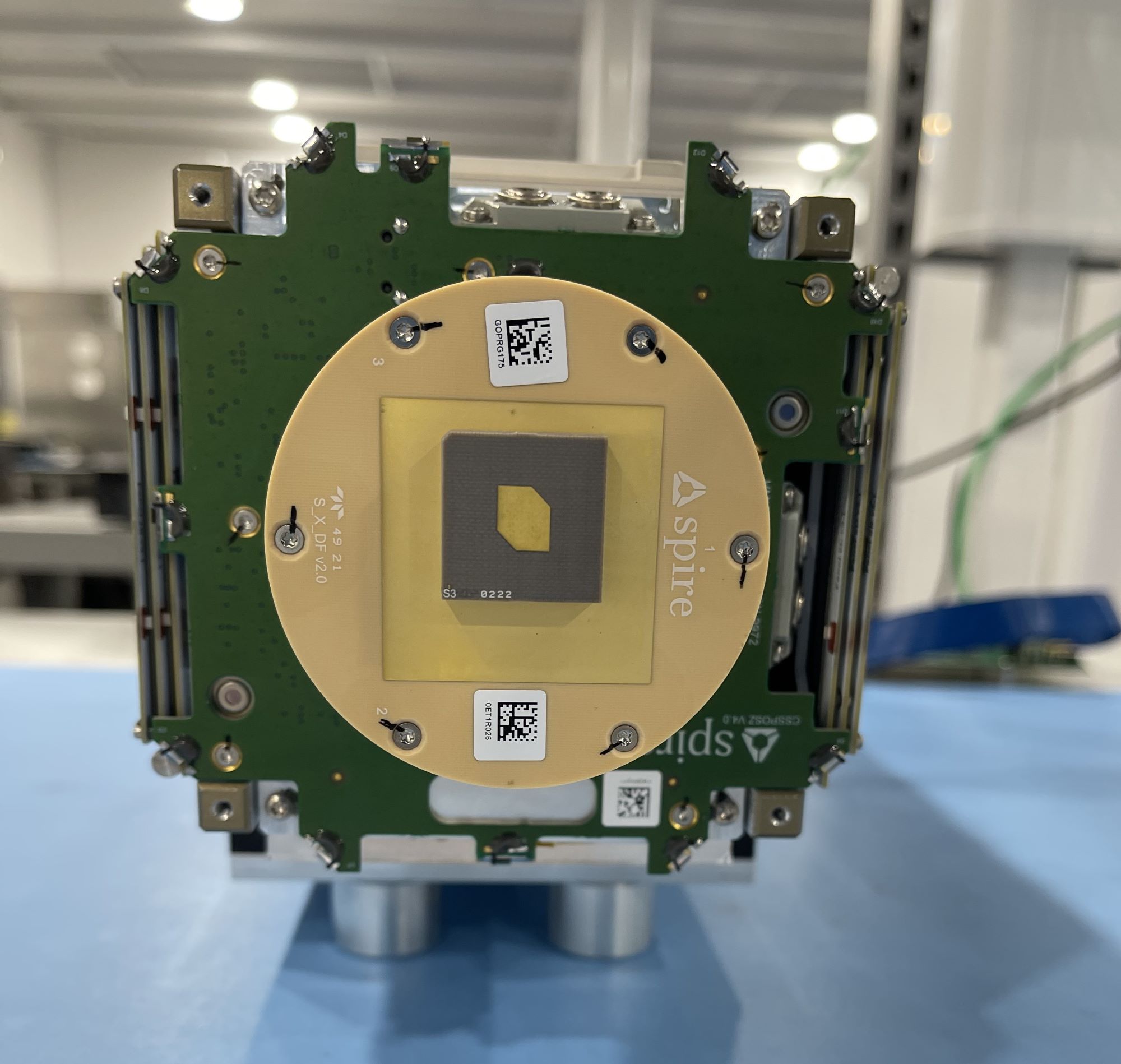
ESA promotes radio frequency monitoring as Spire becomes TPM

The global company Spire, which specialises in using continuous global monitoring to track aircraft, ships and weather patterns using a large constellation of CubeSats, is now an ESA Third Party Mission.

As Earth’s population continues to grow, acquiring high quality data to help to predict the movement of the world’s resources is a priority. A specialist in this field, providing radio frequency datasets in near real-time, Spire Global recently announced that it has officially joined ESA’s prestigious Earthnet Third Party Mission (TPM) programme. The data portfolio that Spire provides will include GNSS-RO polarimetric data (PRO) from the ESA InCubed co-funded PROGRES activity.

Read the full article on www.earth.esa.int.

Image courtesy of Spire

Two ESA Φ-lab-enabled satellites launched

MANTIS, the first satellite mission to be supported from concept to liftoff by ESA’s Earth Observation InCubed programme, has been launched on a SpaceX Falcon 9 rocket. MANTIS carries a high-resolution multispectral camera coupled with a powerful AI processing unit. Intuition-1 was also launched on the same rocket and will similarly demonstrate the advantages of onboard AI capabilities, in this case in tandem with a hyperspectral imager. The satellite’s machine learning algorithms were developed under the ESA-funded Genesis project.

The two satellites lifted off from the Vandenberg Space Force Base in California, US, at 18:49 GMT (19:49 CET, 10:49 PST) on 11 November.

Read the full article on www.esa.int.

Nourishing commercial growth in Earth observation

Hot on the heels of the first Earth Observation Commercialisation Forum, now is a good time to take a look at the all-embracing support that ESA gives to the commercial sector in Europe. With funding programmes, business guidance for companies, and multiyear contracts, ESA provides a vital springboard for continued growth in commercial Earth observation.

The global Earth observation data and service market is estimated to be worth around €2 billion every year and predicted to increase to €7–9 billion by 2032. But despite this wealth of opportunity at a global level, companies in the commercial Earth observation sector in Europe may find getting off the ground difficult owing to the complexity of navigating the investment landscape.

Read the full article on www.esa.int.

Relive the Earth Observation Commercialisation Forum

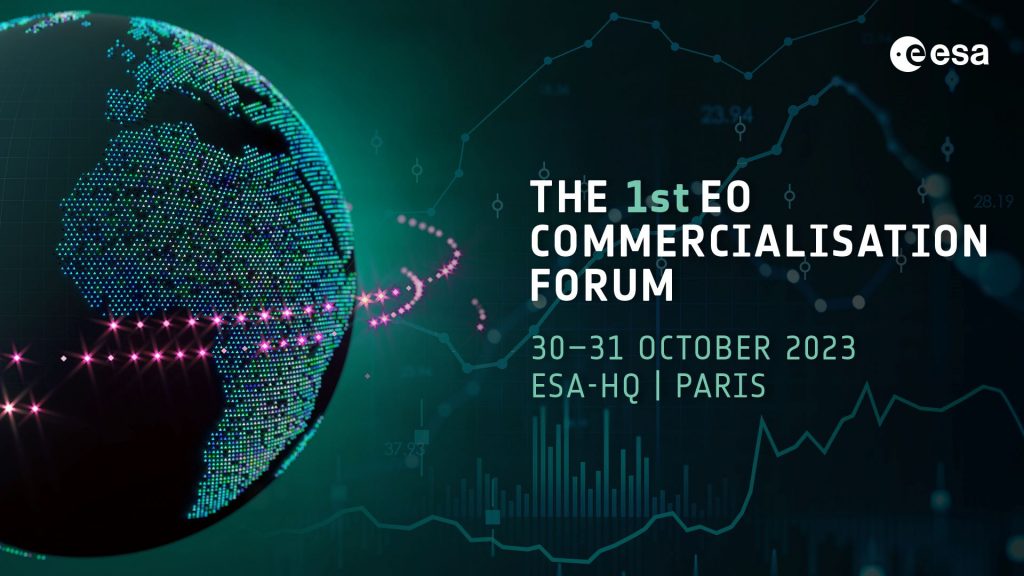
ESA’s first Earth Observation Commercialisation Forum took place at ESA Headquarters in Paris on 30–31 October 2023. The event saw investors, institutions, entrepreneurs and different-sized companies from the Earth observation sector come together to discuss the commercial potential and challenges of Earth observation. Revisit the event by watching the streaming replay.

In his opening address, ESA’s Director General, Josef Aschbacher, said, “Advancing commercial space in Europe is one of the key components of Agenda 2025, which I set as an ambitious vision when I took over the position of ESA Director General.

“The fast-growing Earth observation sector has an abundance of possibilities that private businesses can capitalise on, from satellites and ground infrastructure through to value-added services that address real-world needs with information from space.”

Read the full article on www.esa.int.

Six trends to watch in commercial Earth observation

With a multitude of opportunities for start-ups, established companies and investors, commercial Earth observation is a vibrant sector with fast-moving innovations in technology, datasets and downstream applications. ESA is a key driving force for the development of European Earth observation and provides impetus through its many programmes and initiatives.

To set the scene as ESA’s Earth Observation Commercialisation Forum starts this week, here is some need-to-know background information on the evolution and state of play of the Earth observation industry.

Read the full article on www.esa.int.

Sign up now for the ESA Earth Observation Commercialisation Forum

ESA’s first-ever Earth Observation Commercialisation Forum will open its doors at ESA Headquarters in Paris on 30 October. Registration is still available for this premier two-day event, which will bring together institutions, investors and businesses to explore the commercial potential and funding landscape in Earth observation.

The forum is open to all Earth observation (EO) stakeholders, including entrepreneurs, start-ups, established companies and public and private investment bodies. Attendees will be treated to keynote addresses from ESA speakers such as Director General Josef Aschbacher, Director of Earth Observation Simonetta Cheli and Director of Commercialisation, Industry and Competitiveness Géraldine Naja, along with representatives from the European Commission, venture capitalists and industry leaders.

The speeches, panel discussions and networking sessions will provide a unique opportunity to understand the market trends, major drivers and challenges in commercial EO. With such a wealth of opportunity for connecting up the many and varied players in the sector, the event is sure to be the go-to platform for delving into the state of the art and direction of travel in commercial Earth observation. Full details can be found on the dedicated website.

Register for the Earth Observation Commercialisation Forum here.

To know more: Φ-lab, InCubed, esa.int article

Φ-lab contributes to Earth observation education at ESA-NASA training week

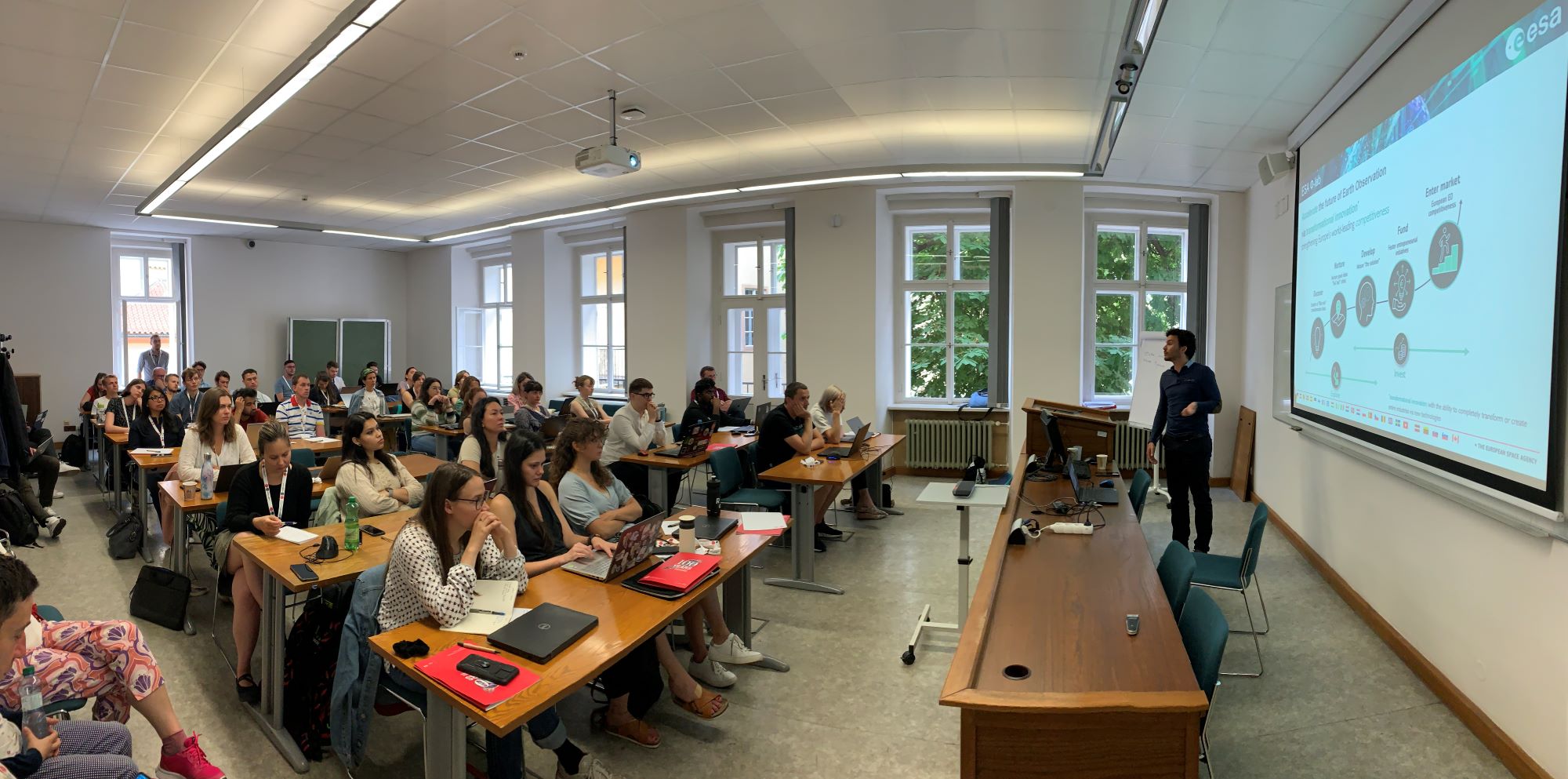
The Trans-Atlantic Training course (TAT 2023) took place in the Czech Republic from 27 June to 1 July and included presentations and tutorials from current and past Φ-labbers. Organised by ESA, NASA and the Charles University in Prague, the course was aimed at educating early-career scientists and post-graduate students on remote sensing for environmental monitoring and modelling.

TAT has been running since 2013 with the objective of providing training activities for young scientists in the field of Earth observation (EO), with a particular emphasis on remote sensing of land-cover change and ecosystem dynamics. The forum shares and discusses advanced space research through a series of workshops, with this year’s edition dedicated to Synthetic Aperture Radar (SAR), passive optical sensing and lidar for forestry, agriculture and hydrology.

Attendees from 18 countries took part and were able to gain a detailed picture of the state of the art in satellite-derived environmental measurement and prediction. The week was split between the cities of Prague and Brno and included insight from a number of global experts in the field.

The expert input included a significant contribution from ESA’s Earth Observation Programme Directorate. Scientific Coordinator Francesco Sarti was part of the TAT organising committee and kicked off Day 1 with an outline of the Agency’s current and forthcoming EO missions. Next was a session introducing Φ-lab and its activities, with talks from Digital Technologies Engineer Bertrand Le Saux, InCubed Officer Albin Lacroix and other Φ-labbers. The session began with a comprehensive overview of how the Explore Office’s research is transforming Earth observation through the application of artificial intelligence, quantum machine learning and other computational methodologies. This was followed by a presentation on the scope, benefits and successes of the ESA InCubed programme.

Day 2 featured a key lecture on applying SAR data time series to forest monitoring. Given by former Φ-lab visiting researcher Daniel Paluba, the workshop was largely based around work carried out at ESA and included two practical sessions, covering topics such as processing Copernicus Sentinel data and comparing Classical and Automatic Machine Learning approaches. This and the other ESA-related presentations were very well-received by the course attendees, with the Φ-lab sessions in particular giving a glimpse into real-world opportunities in EO research and commerce.

“I think it’s crucial that Φ-lab contributes to educational events such as TAT,” Bertrand Le Saux reflects. “Not only is it a pleasure for us to share details of our research and industry support with such an enthusiastic and energetic audience, but I also feel we are helping to plant the seeds for the EO scientists and entrepreneurs of tomorrow.”

To know more: ESA Φ-lab, ESA InCubed, TAT on eo4society, Copernicus Sentinel missions

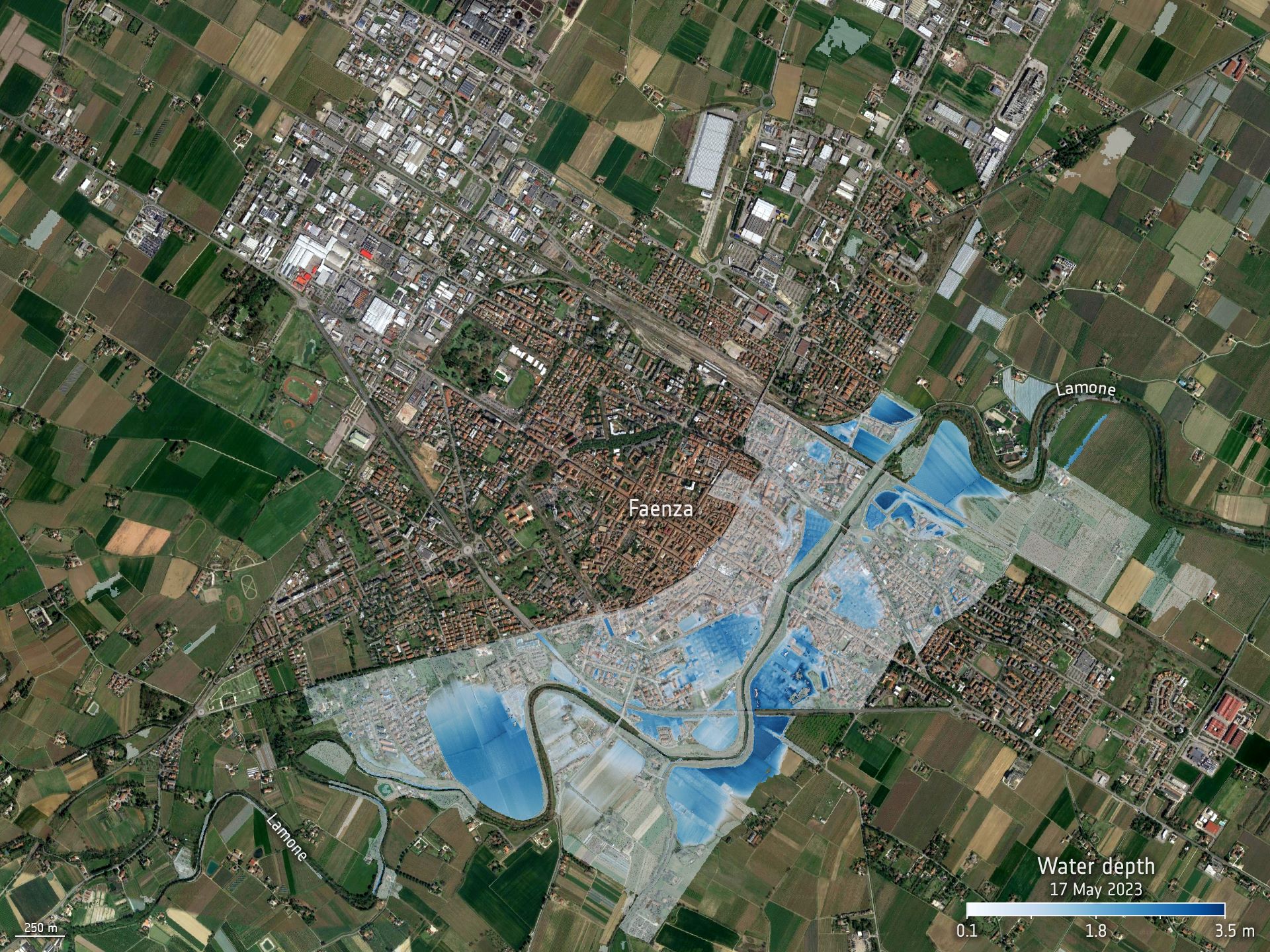
InCubed co-funded SaferPlaces platform maps aftermath of Emilia-Romagna floods

The Italian region of Emilia-Romagna was devastated by severe floods in May 2023, claiming lives and displacing thousands of people, resulting in an estimated €8.8 billion in damages. With the region still grappling with the aftermath, satellites have been instrumental in assessing the damages of the affected areas.

Between 16-18 May 2023, 350 million cubic metres of water, equivalent to six months’ worth of rain, fell within 36 hours across Emilia-Romagna, one of Italy’s most important agricultural regions. The heavy rain led to the overflow of 23 rivers across the region, affecting 100 municipalities and triggering more than 400 landslides, which in turn damaged and closed off hundreds of roads.

Read the full article on www.esa.int.

Φ-lab-WMF AI4EO competition inspires European New-Space start-ups to rise to the challenge

At a recent award ceremony, Φ-lab announced the four winners of the AI4EO Call, a competition launched in conjunction with the We Make Future event. The top entries received a range of prizes, including an all-expense-paid trip to the ESA EO Commercialisation Forum in October.

As a seed bed for innovation in commercial Earth observation (EO), ESA Φ-lab actively promotes and encourages ideas from start-ups and entrepreneurs. We Make Future (WMF) is the largest digital and social innovation festival in Southern Europe, and so provides an ideal forum for Φ-lab to interface with today’s and tomorrow’s success stories in the space sector. In fact ESA has enjoyed a major presence at the gathering since 2020, and this year’s edition in Rimini in Italy featured a popular ESA booth with exhibits that included activities, products and mock-ups from Φ-lab. The multitude of visitors to the booth comprised enthusiasts, start-ups and companies among others, with each taking the opportunity to interact with Φ-labbers and other ESA representatives.

A notable attraction at this year’s event was the AI4EO Call, a joint initiative of Φ-lab and the organisers of WMF. The competition concerned applications of artificial intelligence (AI) and data processing in aerospace and EO and aimed to reaffirm the value of these sectors in international development and the protection of our planet. Entries were assessed by a panel consisting of ESA and industry representatives, based on criteria including project feasibility, degree of innovation, competitive positioning and potential for further development.

Sixteen of the start-ups were shortlisted and invited to WMF to pitch their proposals to the panel. At a dedicated ceremony in the ESA booth, Φ-lab AI Ecosystem Manager Sabrina Ricci announced the four winning applications:

  • FlyPix AI, a geospatial platform that extracts insights from satellite and drone imagery, enabling customers to detect and segment objects of interest, identify their characteristics and monitor changes and anomalies over time
  • SaferPlaces, an AI-based digital twin solution that uses satellite and climate data to deliver flood risk intelligence for urban environments
  • Terroir from Space, a service for the wine industry that both detects unexploited planting sites and monitors existing vineyards through AI processing of EO data
  • Latitudo 40, an analysis engine that draws on Deep Learning algorithms to provide customers with satellite-derived information on topics such as land use, carbon sequestration and coastline erosion

The first-prize winners, FlyPix, won a trip to the ESA EO Commercialisation Forum in October, where they will participate at an ideas-pitch session with private investors. Other prizes for the runners-up included access to business and technical coaching on EO and a subscription to the Sentinel Data Hub.

“We’re truly grateful to have had the opportunity to take part in the AI4EO competition at WMF 2023 and were overjoyed to be selected as the winners,” commented FlyPix co-founder Sergey Sukhanov. “Not only did this experience allow us to showcase our progress, but it also provided a platform for networking with other participants and exploring potential collaborations. In addition, the EO Commercialisation Forum will be a fantastic chance for us to present our product to a new audience.”

Head of the Φ-lab Invest Office Michele Castorina was impressed by the competition’s take-up: “There has been a striking response to the AI4EO Call, with an extremely broad range of ideas that amply demonstrate the vigour and continuing growth of European innovation. We’ve also had a great deal of interest shown in the ESA InCubed programme, giving a number of possibilities for future co-funding of EO start-up activities.”

To know more: ESA Φ-lab, ESA InCubed, We Make Future, AI4EO Call, ESA EO Commercialisation Forum

Image courtesy of WMF – WeMakeFuture