

Φ-lab manages or contributes to several ESA flagship programmes that are expected to massively accelerate the way Earth observation will impact our society


EOCognitiveLab will be an Earth Observation (EO) in-orbit laboratory, bringing together the Cognitive Cloud Computing in Space for Earth Observation (3CS4EO) vision and the Φsat-3 initiative into a single EO mission.
Building on the heritage of Φsat-2, the EO Virtual Constellation, and 3CS4EO studies, EOCognitiveLab will capitalise on proven technologies, operational experience and a growing user community. The mission will consist of two core satellites flying in formation and is designed for future expansion through federation with additional space and ground assets. EOCognitiveLab will demonstrate autonomous constellation orchestration, event-driven acquisition replanning, cooperative sensing, and low-latency information delivery enabled by advanced edge and cloud computing in space. As an open and expandable testbed, it will provide unique datasets and enable the EO community to develop, deploy and validate new applications, technologies and algorithms directly in orbit.

AI for Earth Observation (AI4EO) focuses on harnessing the power of Artificial Intelligence with the vast volume of EO data now available, and as one of Φ-lab’s key initiatives, will exploit the enormous and yet largely untapped potential of AI.
There are many areas of Earth Science, Earth System predictability and Big Data analytics that will benefit from AI, and Deep Learning in particular is pushing the envelope to new levels that are way beyond human performance. The Earth observation research and business communities are now rapidly awakening to these opportunities and implementing this innovation in operation scenarios.
Learn more AI4EO CHALLENGES
ESA Φ-lab supports a full Earth observation foundation model lifecycle:
This holistic framework underpins the vision of Earth observation systems that learn, reason and operate across the entire space–ground continuum, forming the conceptual basis for Cognitive Cloud Computing in Space (3CS) and the emerging World Agentic Engine – a unified, intelligent layer connecting orbital, edge and ground segments through adaptive, AI-driven geospatial reasoning.
Read more
InCubed is ESA’s Earth observation public-private partnership commercialisation programme that supports the development of innovative and commercially successful products and services. We encourage high-risk/high-reward developments by mitigating the technical and financial risks through co-funding of business ideas.
Learn more
The Φ-lab Quantum Computing for EO (QC4EO) initiative has been set up to tackle the most computationally demanding EO problems with the much-anticipated Quantum Computing capabilities of the next computer generation. Quantum Computing promises to improve performance, decrease computational costs and solve hard problems in EO by exploiting quantum phenomena such as superposition, entanglement and tunnelling. Use cases examples are mission planning for EO heterogenous constellations, multiple-view geometry integration of EO Images, SAR raw data processing, variational QC4EO image processing, climate adaptation digital twin HPC+QC workflow, uncertainty quantification for remotely sensed datasets. The QC4EO initiative is in collaboration with several research centres and industries, aiming at the creation of a quantum capability in ESA-ESRIN to support programmes such as Destination Earth, Digital Twin of the Earth and Copernicus
Learn more
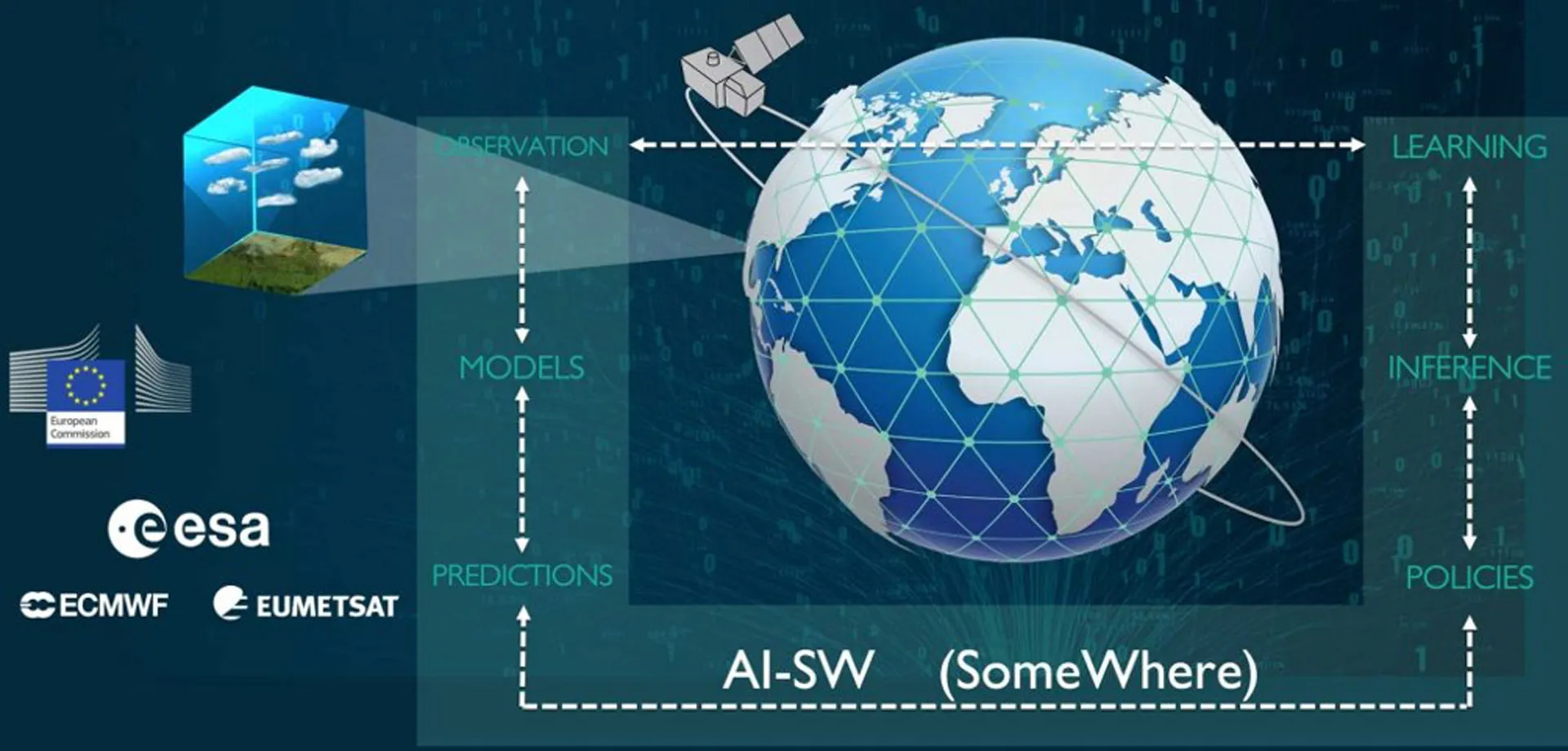
Destination Earth (DestinE) is a European Commission initiative to develop an ambitious AI-driven decision-support system based on a very high accurate digital model of the Earth, to monitor and simulate natural and human activity, along with developing and validating policy scenarios. ESA participates in the initiative by leading the overall effort, in collaboration with EUMETSAT and ECMWF. ESA Member States have initiated a companion programme, the ESA Digital Twin Earth (DTE), to foster the exploitation of DestinE data for Earth observation and innovation.
ESA Member States have initiated a companion programme, the ESA Digital Twin Earth (DTE), to foster the exploitation of DestinE data for Earth observation and innovation.
Φ-lab actively supports the activities of DestinE and ESA DTE to bring the demonstrated analysis and reasoning capabilities of AI technologies to the heart of the operations, along with stimulating further exploitation by various user communities. DestinE will use unprecedented observation and simulation products, powered by Europe’s HPC computers and AI power, to push the limits of computing, forecasting, planning and acting.
The DestinE core service platform (ESA), the data lake (EUMETSAT) and the initial digital twins (ECMWF) will be developed and progressively transferred into operations over the next 7-10 years as part of the Digital Europe Programme. The European Commission (DG-CONECT) coordinates the initiative in close collaboration with other relevant EU programmes or projects like Horizon Europe for research and innovation opportunities, the EuroHPC Joint Undertaking for HPC usage and the European Space Programme for Copernicus data usage.
 Learn more

The ESA Φ-lab 3CS initiative is aimed at developing an agile platform for in space testing of the Cognitive Cloud Computing in Space concept which is based on a network of in space agents endowed with sensing (i.e. EO sats) and/or processing and/or communication capabilities where this EO transformative concept can be explored.
This concept is identified as the next step of evolution of EO systems of the future and is an evolution of what is the Φ-sat series to a disruptive concept of in-orbit EO capabilities that exploit all elements of ICT revolution and liberate new business, and operational modes enabled by the availability of in-orbit infrastructure.


