September 23, 2026
Exploring EVE with two new humanoid robots


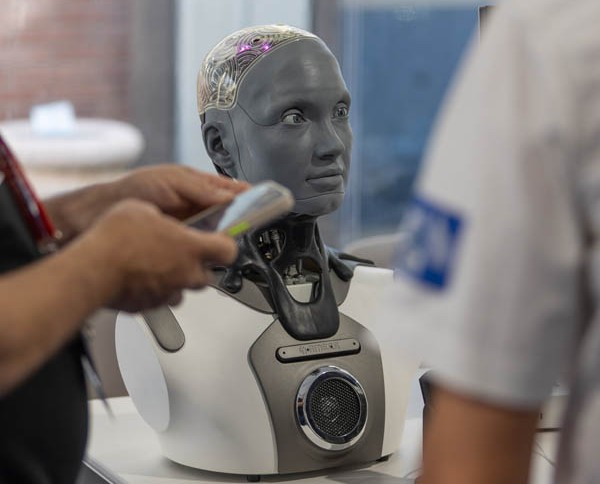
Over the last years, ESA Φ-lab and Pi School have carried out the development of EVE (Earth Virtual Expert), a new intelligent companion for exploring the world of Earth observation and Earth sciences, with support from Imperative Space, Mistral AI and Wiley. Two new humanoid robots, Ameca and Frankie, make interactions with EVE more accessible and engaging.
Navigating today’s vast influx of Earth observation and Earth sciences data and information can often feel like searching for a needle in an endless digital haystack. From tracking climate patterns to monitoring crop health, Earth observation offers valuable insights. Uncovering these insights, however, usually requires specialised, technical expertise.
Two new humanoid robots show that exploring our ‘pale blue dot’ does not have to be complicated. Rather than sitting behind a computer and deciphering dense code, people can now explore EVE (Earth Virtual Expert), a chat-based platform designed to revolutionise how we interact with Earth observation and Earth sciences, simply by starting a conversation.
Developed by Frank Reply GmbH, Ameca and Frankie are two humanoid robots created to make interactions with EVE more accessible and engaging. Equipped with built-in cameras for real-time visual analysis of images on a screen, this robotic duo is able to interpret queries in natural language.
While EVE does the heavy lifting of Earth observation data analysis, these two new guides offer a fully interactive experience.
Ameca is the expert for satellite image searches. People can speak directly to Ameca, who interprets plain-language requests to locate and retrieve the most relevant satellite imagery from EVE’s database. Frankie is the enthusiastic expert for vegetation analysis. By looking at a satellite image on a screen, he breaks down Earth observation concepts such as NDVI (Normalised Difference Vegetation Index) into engaging conversations.
Daniel Fitzpatrick, Senior Manager at Frank Reply, commented: “By using the conversational interface, we are able to democratise Earth observation operations. In the past, due to the vast amounts of data involved and scientific expertise necessary to execute successful queries, highly specialised knowledge was a pre-requisite.”
“Using natural language, people can simply ask for specific Earth observation imagery (for instance of their hometowns) and then watch in real-time as their requests are rendered into machine language using the EVE toolchains. We are looking forward to continuing our collaboration with ESA Φ-lab and will be hosting a demo and hands-on session at the ‘Agentic AI for Earth Observation’ workshop in Berlin this October”, Daniel added.
These robots offer three ways to experience EVE’s technology: an interactive image recognition game guided by Ameca, an NDVI-based crop-health inspector led by Frankie, and the EVE ‘Behind the Scenes’ mode.
For those curious about how intelligent assistants process complex requests, the ‘Behind the Scenes’ mode shows how EVE’s ‘brain’ works. As people speak to Ameca, a dedicated screen reveals every step of EVE’s operational workflow in real time, showing retrieval, reasoning, planning and tool calls as they happen.
By fusing an advanced, low latency speech-to-speech AI model with EVE’s underlying agent capabilities, satellite workflows and grounded data retrieval, Ameca and Frankie transform a complicated data science task into a fluid, natural conversation.
Ultimately, this ‘sneak peek’ of EVE shows that conversational interfaces are going beyond simplifying technology and into making Earth observation transparent, approachable and fun. By allowing users to talk their way through satellite data and get a real feel for space technologies without having to understand them first, EVE is making the wonders of Earth observation and Earth sciences open to everyone.
“The real breakthrough here is how these conversational interfaces turn complex Earth observation technology and knowledge into a natural dialogue. We no longer need to speak the specialised language of remote sensing to understand what the data are telling us”, commented Nicolas Longépé, Earth Observation Data Scientist at Φ-lab and EVE’s Technical Officer.
“Anyone, from curious citizens to policymakers, can now simply ask a question and explore satellite intelligence, just like talking to a friend. Besides making EVE more transparent by showing its inner workings, these conversational interfaces also represent a major step forward in truly democratising Earth observation knowledge”, Nicolas added.
Do not miss EVE’s demo and hands-on session at the ‘Agentic AI for Earth Observation’ workshop (Berlin, Germany) in October. A fully operational version of EVE will be launched soon. Register for the public launch and read more about it on the EVE website.
To know more: ESA Φ-lab, Frank Reply GmbH.
Photo courtesy of Unsplash/Gabriele Malaspina