ESA title

InCubed funding contract signed for DFKI’s AI4EO Solution Factory

ESA InCubed and the German Research Center for Artificial Intelligence (DFKI) have signed a contract to support a new development initiative focused on Artificial Intelligence for Earth Observation (AI4EO). The three-year programme will involve setting up an innovation seedbed where DFKI’s AI experts will collaborate with major industry players on new EO business cases.

Earth observation is enjoying an ever-widening field of applications, from crop yield forecasting and land cover detection to urban planning and disaster management. However, with the sheer volume of data generated, simple manual analysis is often no longer practicable, giving rise to the need for automatic Artificial Intelligence (AI) tools such as Machine Learning (ML).

In order to provide such tools for commercial customers, the Deutsches Forschungszentrum für Künstliche Intelligenz (DFKI) is creating the AI4EO Solution Factory. Co-funded by the ESA InCubed programme, the AI4EO Solution Factory will combine the market knowledge of industry partners with DFKI’s AI expertise to provide customised algorithms for satellite data exploitation.

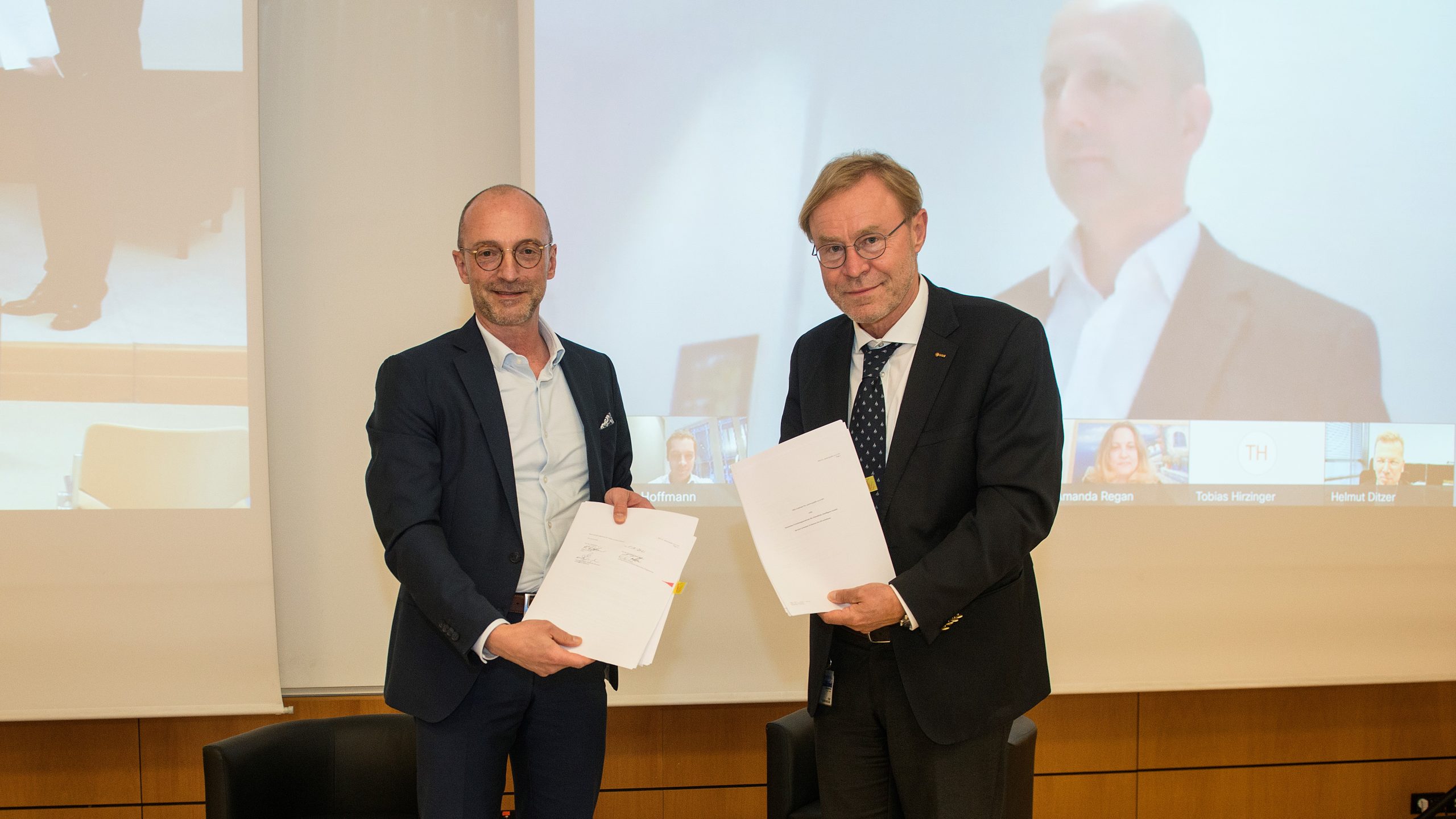
The funding contract for the AI4EO Solution Factory was confirmed yesterday at this year’s ESA Φ-week event. Commenting at the signing ceremony, ESA Acting Director for Earth Observation Programmes Toni Tolker-Nielsen emphasised the landmark nature of the activity: “I’m very pleased to be here for the launch of this initiative, which is the first of its kind supported by ESA. We see a great deal of potential in the AI4EO Solution Factory, and I look forward to following its progress in delivering AI-powered EO solutions to customers.”

“This exciting InCubed activity will allow DFKI, together with major German industry partners, to show what great benefits Earth observation can unfold through the use of AI. We anticipate that the AI4EO Solution Factory will break new ground in the commercialisation of Earth observation for various industry sectors,” added Michael Nyenhuis, InCubed Programme Coordinator at the German Space Agency at DLR.

Prof. Andreas Dengel, Executive Director at DFKI Kaiserslautern and Head of Smart Data & Knowledge Services, spoke of some of the envisaged benefits: “The AI4EO Solution Factory creates a collaborative environment to open up new business scenarios in the field of Earth observation, based on the combined expertise of DFKI and ESA, and to develop customised AI solutions for partners and users. Our transfer lab ESA_Lab@DFKI, which was founded at the beginning of the year, also provides the perfect framework to explore further technology needs in ESA projects and help shape modern space applications and resulting business models with the latest AI methods.”

DFKI Project Manager Marlon Nuske explained the Solution Factory’s model: “The central idea is to leverage synergies from the development of AI solutions for various Earth observation use cases. While each individual solution will be unique in its applications, many of the underlying building blocks can be reused for additional products and projects.”

“The support from InCubed will inject some essential financial impetus into the AI4EO Solution Factory,” Mr. Nuske continued. “We’re officially kicking off this week, with several leading industrial corporations already on board for the first joint product development in the agricultural sector.”

ESA Technical Officer Nicolas Longépé was enthused by the Solution Factory’s prospects: “This is the largest ever InCubed initiative with a German partner, and we’re certain the AI4EO Solution Factory will produce important advances in AI-driven EO applications over the next three years and beyond. The genesis of the collaboration, initially between DFKI and the Φ-lab Explore Office and now with InCubed, is a salient example of our ‘innovate and apply under-one-roof’ approach.”

To know more: AI4EO Solution Factory Activity page,DFKI, Φ-week


Photo Copyright: Valentina Stefanelli

Spotlight on climate and the New Space economy

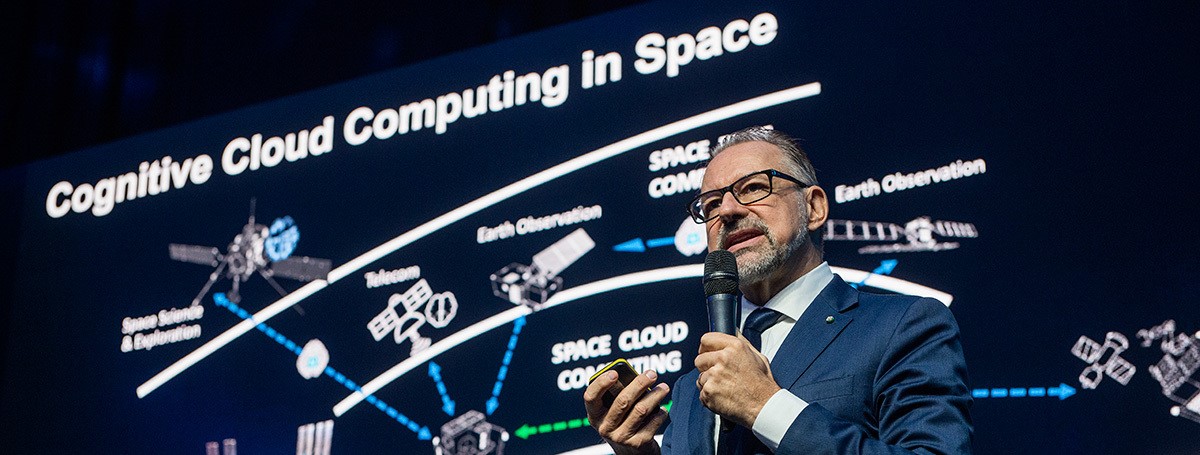
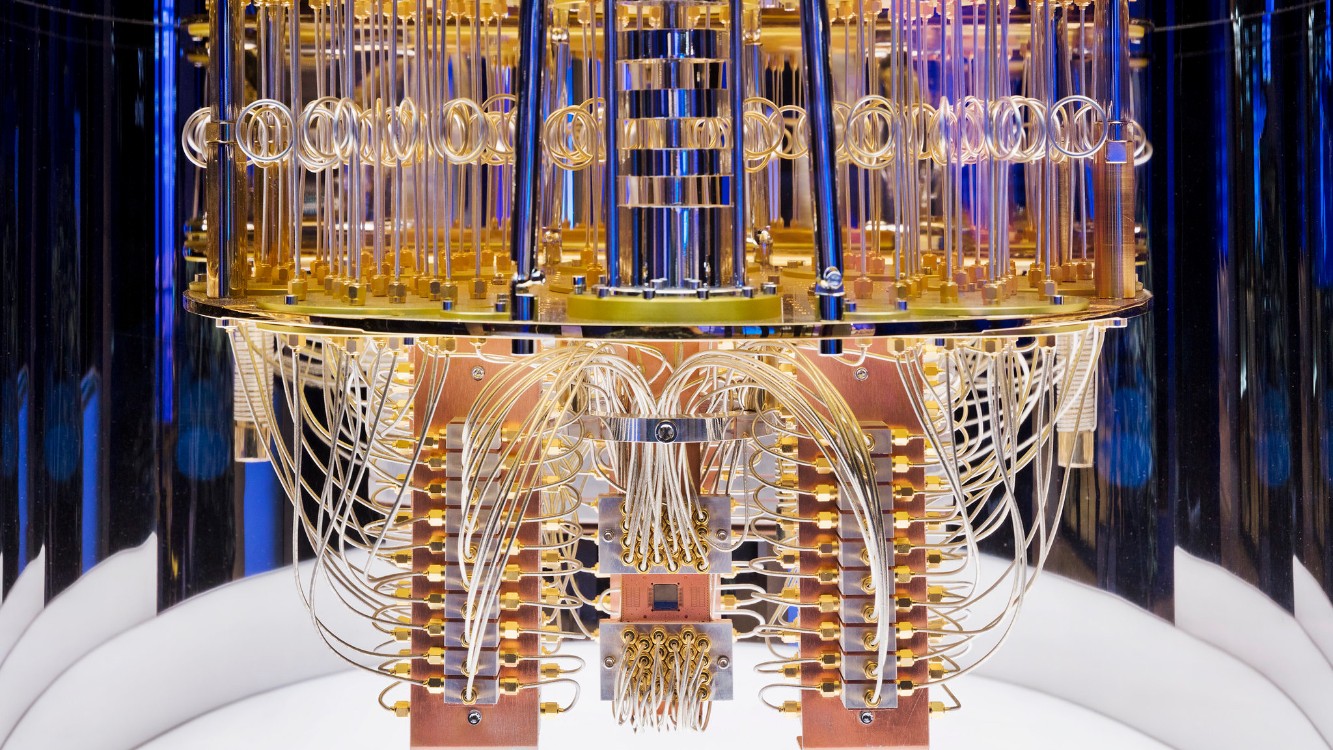
Kicking off with a bold flourish, Φ-week 2021 promises to bring space even closer to the forefront of addressing society’s biggest challenges, namely issues associated with the climate crisis, while boosting the economy through transformative New Space, artificial intelligence, and quantum and cognitive computing.

ESA’s Φ-week is now in its fourth edition, and each year this forward-looking event is increasingly relevant to society, business and the economy.

In his opening address, Josef Aschbacher, ESA’s Director General said, “Europe faces unprecedented societal, economic, and security challenges. Space has enormous untapped potential to play in tackling pressing current and future crises, while simultaneously providing new impulse for the European space sector. We need to develop smart, automated services and applications to protect lives of people and to increase the protection of assets and natural resources.”

Read the full article on www.esa.int


Photo Copyright: Valentina Stefanelli

SSTL to develop intelligent downlink architecture with InCubed co-funding

Timed to coincide with this year’s Φ-week event, ESA InCubed and Surrey Satellite Technology Ltd (SSTL) have announced a new initiative to design and test a high-throughput payload downlink chain for small Earth observation satellites. The module aims to provide data processing and transfer capabilities that are future-proofed for tomorrow’s onboard imagers.

Current and even more future satellite imaging payloads are generating multi-dimensional, high-volume data that can exceed the throughput capacity of small satellites. To tackle this data bottleneck, a consortium of the University of Surrey, Craft Prospect Limited and SSTL has been formed to develop product enhancements for the latter’s Flexible & Intelligent Payload Chain (FIPC) solution.

The advanced hardware architecture of SSTL’S FIPC will provide the basis for a new intelligent and adaptive data downlink, along with a state-of-the-art framework for software-defined data processing onboard the satellite. Processing tasks may include data calibration, data compression, image thumbnailing and Machine Learning (ML) for image classification.

SSTL Managing Director Phil Brownnett set out the vision for the leading-edge payload chain: “The FIPC solution will significantly improve the capabilities of small Earth observation satellites by increasing data rates to match the capacity of the onboard imager system. This will boost both the volume and complexity of the data that can be downlinked on a single satellite pass – a step up in performance that will match our customers’ business plans and ambitions.”

SSTL, Craft Prospect Limited and the University of Surrey will work together on the FIPC solution and onboard processing applications. Following the design phases, the consortium will demonstrate and evaluate the unit’s features on a flight-representative testbed.

Carlos Urbina Ortega, ESA Technical Officer for the activity, sees a number of advantages to be gained from the FIPC: “We envisage substantial benefits from this InCubed investment, not least because of the system flexibility and computational power that the FIPC affords. Capabilities such as onboard ML acceleration for enhanced data management and services, together with in-orbit application reconfiguration, will ensure that small-satellite missions remain agile and end-user focused.”

To know more: FIPC Activity Page, SSTL, Φ-week

Watch live: ESA Φ-week

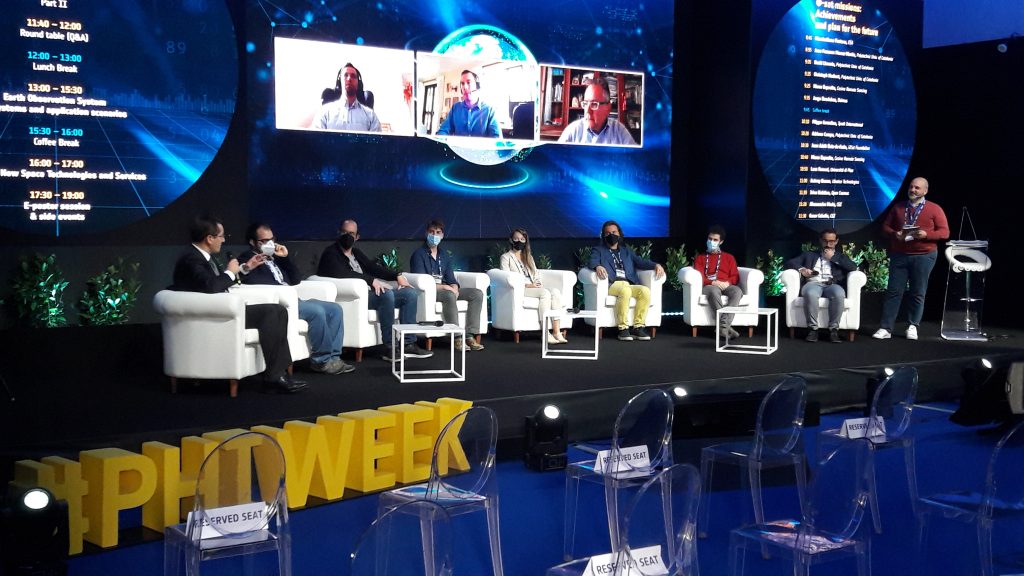
Focusing on the New Space economy and innovations in Earth observation, ESA’s fourth Φ-week kicks off on Monday 11 October. Join us live for two of the main sessions: the Opening session on Monday at 10:30 CEST and the Blending New Space Technologies and Services session on Tuesday at 16:00 CEST.

As the world starts to return to normality in the wake of the COVID pandemic, this year’s Φ-week is a hybrid event, with registered participants attending virtually and invited speakers present at ESA’s Centre for Earth Observation in Italy.

However, part of this not-to-be-missed event can be enjoyed by all – simply tune into ESA’s Web TV and following the live transmission links. 

Read the full article on www.esa.int

Mayday.ai develops its AI-automated platform under InCubed programme

Mayday.ai GmbH will launch a new AI-automated platform in Europe developed with the support of the ESA InCubed programme and the German Aerospace Centre (DLR) for its next-generation disaster and risk information services.

Mayday.ai GmbH will deliver a centralised and AI-based platform providing real time and near real time disaster and risk information services. This German-based start-up provides early warning and (geostationary, polar), camera imagery, audio as well as social media sentiment analysis.

The solution, which runs on an agnostic AI fusion engine, will be available for government agencies, international organisations, first responders, insurance and utility for up to 18 disaster types with native language support.

Mayday.ai’s proposal was selected under the ESA’s programme InCubed Investing in Industrial Innovation with the support of the German Aerospace Centre (DLR), and was kicked-off in July 2021.

The development aims at further enhancing Mayday.ai’s disaster management platform and adapting it to the European setting and its neighbouring regions. It also supports the development of additional disaster management products as well as accelerating Mayday.ai’s global expansion.

We are delighted that ESA and DLR have recognised our technological edge and potential, and grateful for their continuing support in our global growth out of Europe as we build our platform on the Sendai Framework principles. Our innovations will cater to the nuanced community needs globally, with the support of a community-owned model, as well as scenario-based automated notifications. Climate resiliency is within reach in case of many disasters with a culture shift towards proactive prevention, as opposed to the currently fragmented and highly reactive one. More importantly, in addition to saving lives, property, cultural and natural heritage, it also costs remarkably less to accomplish” states Mayday.ai’s Founder and CEO, Kian Mirshahi.

Bertrand Le Saux, ESA Technical Officer, added: “The Mayday.ai platform will provide a next-generation, centralised solution to organise a timely and coordinated response to natural hazards. It will leverage real-time satellite imagery and AI-enhanced predictive analytics to provide automated detection, early warning and integrated two-way communication services for various types of incidents.”

After a number of successful global pilots, the Mayday.ai team will be releasing its enterprise version of its platform in a partnership with Esri, the Environmental Systems Research Institute. In autumn 2021, the company aims to officially launch its efforts to boost community-based resiliency through various global campaigns.

More information on Mayday.ai GmbH InCubed activity can be found here.

Mayday.ai Real Time Disaster Information Web based Platform in Esri.

To know more: Resilient Europe 2.0, Mayday.ai, Mayday.ai Linkedin, German Aerospace Centre (DLR)

InCubed releases a dedicated call for Danish companies


Are you a Danish start-up or company working in Earth observation and using satellite data? Apply now for the InCubed Denmark call here. The deadline is 22 August.

InCubed stands for ‘Investing in Industrial Innovation’ and is a Public Private Partnership co-funding programme run by the ESA Φ-lab that focuses on developing innovative and commercially viable products and services that exploit the value of Earth observation imagery and datasets. InCubed has a very wide scope and can be used to co-fund anything from building satellites to ground applications and everything in between as well as the development of new EO business models.

The programme works in  very close cooperation with its participating Member States and can issue dedicated country-oriented calls as the one just published for Denmark.

In 2021, Danish companies and commercially focused research institutions can apply for up to 3.4 million Danish Kroner in co-funding for the development of innovative and commercially sustainable technology, products and services using Earth observation data through ESA’s InCubed programme.

The call and application form are available online on: link.

The deadline for submitting project pitches to ESA and the Danish Agency for Science and Higher Education is Sunday 22 August.

Idea pitches and proposals are assessed by the Danish Agency in an open competition, based on specific criteria including growth and competitiveness, level of innovation and societal impact. Once evaluated, successful applicants will receive a Letter of Support, which is required to finalize the application process with ESA.

Read more about the national process at the Danish Agency for Science and Higher Education website.


To know more: InCubed – How to Apply, Danish Agency for Science and Higher Education, UFM article promoting the call (in Danish)

Luxembourg-based company RSS-Hydro joins InCubed family

With a project called FloodSENS, the Luxembourg-based company RSS-Hydro is now part of ESA’s InCubed programme. The project aims to develop an algorithm that efficiently identifies flooded areas under partial cloud coverage in optical satellite images, using Machine Learning and auxiliary high-resolution data from drones, digital elevation models, as well as water flow algorithms.

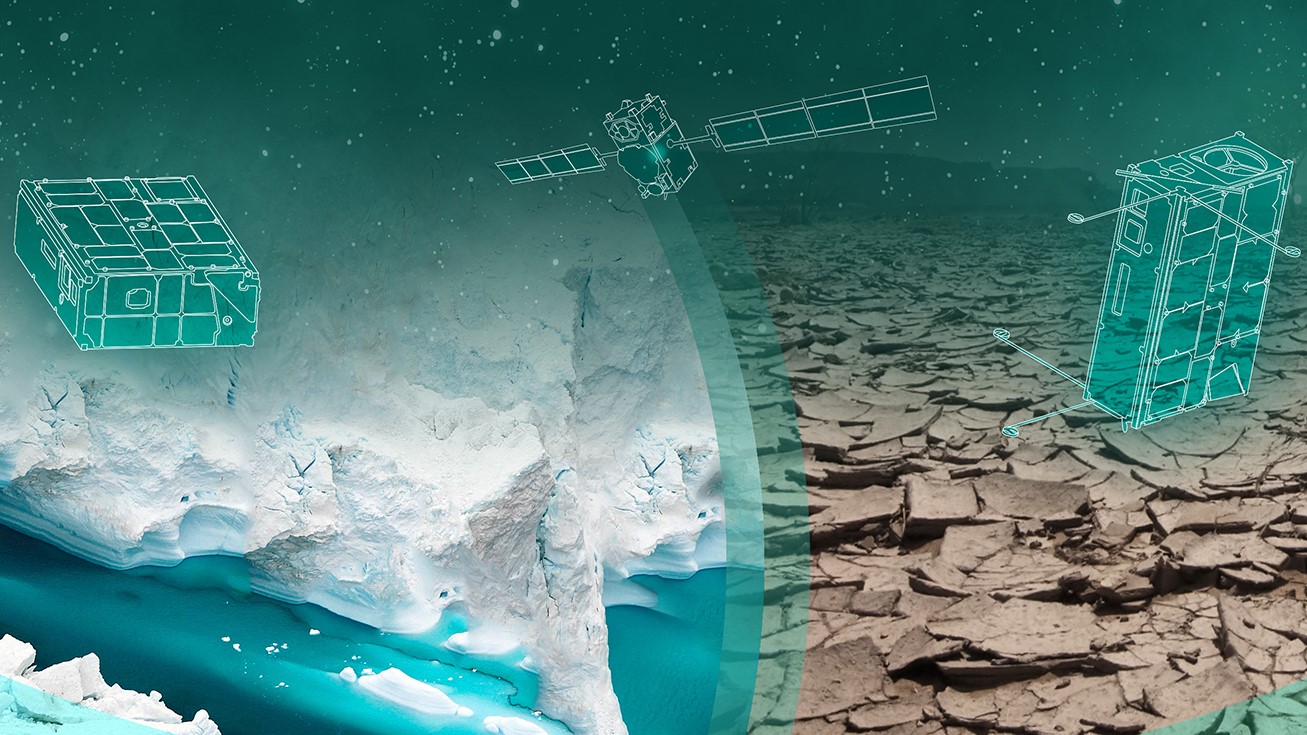
Floods are one of the most devastating natural disasters, accounting for the highest insured and uninsured losses annually, as well as costing many lives. The climate emergency intensifies the hydrological cycle. Consequently, the frequency and magnitude of extreme hydro-meteorological events, and therefore the risk of floods, are increasing, as confirmed to be happening in many places around the world. This flooding increase has devastating consequences, among which are a greater strain on humanitarian response efforts and the financial risk of the global (re)insurance market.

With the support of ESA InCubed programme, RSS-Hydro has now started to work on FloodSENS, a service that specifically addresses these issues by developing a flood mapping application for the open market that overcomes one of the major limitations of optical EO imagery during floods and is capable of efficiently scaling between optical satellite and drone images. Therefore this novel application would be able to efficiently reconstruct flooded areas under partial cloud cover in optical satellite images.

Guy Schumann, RSS-Hydro CEO, said: “This type of application is especially important for disaster response agencies at regional, national, and international level, who are keen to utilize the proliferation of open satellite data for flood mapping during emergencies. Additionally, in the insurance and re-insurance markets, stakeholders are interested in EO data to map the flood hazard of a high-impact event and, on a historical basis, to understand risk exposure and the changing nature of it.”

Bertrand Le Saux, ESA InCubed Technical Officer, added: “FloodSENS integrates both drone data and EO imagery with Machine Learning, to offer the best support to emergency response activities, as well as to the re-insurance market. At ESA, we see a big potential in this activity and we are ready to support it until its entry into the market”.

For Europe, but also for many other countries worldwide, future innovative EO-based and Machine Learning-powered apps would add considerable benefits to the existing products and services of the free Copernicus Emergency Management Service (EMS) and beyond. RSS-Hydro’s FloodSENS will position itself at the intersection of these two fields (EO technologies and Machine Learning application tools) and at the forefront of future EO-enabled innovative solutions, enabling a much more effective disaster response.

More information on the FloodSENS InCubed activity can be found here.


Image caption: The first half of 2019 was a devastating period for many countries in southeast Africa. After Cyclone Idai destroyed many places, in particular the port city of Beira, at the start of the year, Cyclone Kenneth ravaged northern Mozambique. Entire villages were destroyed and almost one million people were put at risk in the area. This partial cloud-free subset of a Sentinel-2 image from 3 May 2019 shows large areas under water in Pemba, regional capital of Cabo Delgado state, which experienced over 2 m of rain and flooding. FloodSENS will render optical imagery like this more usable during floods by reconstructing flooded areas under cloudy skies.


Links: FloodSENS, RSS-Hydro, Company Linkedin

OHB joins forces with ESA Φ-lab to boost the EO commercial market

With the common objective to explore transformational technologies targeting the growing Earth observation commercial market, ESA Φ-lab and OHB have signed a Letter of Intent to define their basis for cooperation.

With the aim to define and develop transformative commercial services powered by Earth Observation (EO) space-based data and to foster the development of associated transformational technologies, OHB has reached an agreement with ESA Φ-lab to gain access to its unique capabilities and support. The cooperation may be extended in future to a joint research effort with OHB visiting researchers at the ESA Φ-lab.

“The commercial EO market has been following a fantastic evolution in the past decade, and it is essential for OHB to keep the pace and prepare solutions to the challenges of tomorrow. The cooperation with the ESA Φ-lab will foster the creation of transformative services representing a breakthrough to end-users.” says Sebastien Tailhades, Domain Manager Earth Observation at OHB.

Giuseppe Borghi, Head of the ESA Φ-lab, commented: “The ESA Φ-lab is the home of EO transformative technologies and commercial approaches within ESA. I strongly believe in compelling partnerships as a means to accelerate the EO future. We are very happy to add this new exciting collaboration to others already running at the ESA Φ-lab with industries, research centres and private investors. We look forward to transformative results!”


To know more: OHB, ESA Φ-lab

Primo Space Fund and ESA Φ-lab sign an agreement to boost New Space Economy

Primo Space, a venture capital fund specialising in investments in the New Space Economy, and ESA have signed an agreement with the aim of joining efforts to support the growth of start-ups in the Earth observation Space Economy commercial sector. The collaboration will be coordinated by the Φ-lab, a division of ESA with a specific focus on fostering transformative innovation and its commercialization in the Earth observation segment.

The ESA Φ-lab mission is to accelerate the future of Earth observation. The lab also runs the commercial programme called Investing in Industrial Innovation, or InCubed, which is a 100+ M€ co-funding programme that focuses on developing innovative and commercially viable products and services exploiting the value of Earth observation imagery and dataset assets.

The activities of this collaboration between Primo Space and ESA Φ-lab range from exchanging information, organising events, highlighting common investment opportunities, to providing joint support to project activities partners and in general de-risking entrepreneur efforts and so increasing their success rate for both ESA InCubed and Primo Space Fund.

New Space is an extraordinarily dynamic sector of the space economy that is attracting the attention not only of industrial players but also of the investment community worldwide. Decision-makers worldwide are also increasing their attention to it. This is also happening because its effects can pervade almost every segment of economic activities and to some extent even everyday life.

“We believe that, in addition to making investments capable of creating value, which remains the primary objective of our activity, it is also important to contribute to the formation of a cohesive and determined ecosystem that favours the development of start-ups that create great innovations. This agreement goes exactly in that direction”, said the General Partners of Primo Space Fund – Matteo Cascinari, Raffaele Mauro and Giorgio Minola.

Giuseppe Borghi, Head of ESA Φ-lab, also commented: “The partnership with Primo Space Fund is a key step for us at ESA Φ-lab to support our commercial programme InCubed, which sees already 29 investments made in just 3.5 years (4 concluded and 3 already generating revenues) opening to Earth observation commercial entrepreneurs a privileged access to the private investors world to support their growth driven by disruptive innovation. Primo Space acts mainly in Italy, which is an InCubed key contributing country and we expect there a strong impact from this partnership.”


To know more: Primo Space Ventures, Primo Ventures LinkedIn

Get ready for the ESA-ECMWF workshop on Machine Learning for Earth System Observation and Prediction

ESA and ECMWF are organising the second joint workshop on Machine Learning for Earth System Observation and Prediction that will be hosted from 15 to 18 November in an hybrid format. The call for abstracts is currently opened until 28 July. Participants registrations will start in August 2021. Submit your proposals.

The advantages of Machine Learning/Deep Learning (ML/DL) Artificial Intelligence techniques have been proven in a wide range of applications such as image recognition, traffic prediction, self-driving vehicles, and medical diagnosis. These techniques have also gained popularity within the Earth System Observation and Prediction (ESOP) community due to their ability to improve our understanding and prediction capabilities on the Earth’s complex and wide-scale dynamics.

Supported by the continuous increase in computing power, these techniques are valuable to automatically process and analyse a large range of available data but they still present some limitations, as for example the case of DL methods that need large amounts of curated and labelled data.

The workshop on “Machine Learning for Earth System Observation and Prediction” from 15 to 18 November, organised by ESA and ECMWF, will aim to demonstrate where and how this fusion between traditional ESOP techniques and new ML/DL methods reached a remarkable impact. It will also help to identify the remaining issues to be further explored. Presenters will demonstrate their contributions to this challenge and expand the discussion to provide a general overview of the subject.

After the first three days, covering the state-of-the-art, the working groups will discuss in parallel the current limitations and suggest how to advance so as to extract more value from this powerful fusion.

The output of the workshop is in the form of working group reports, which will be then summarised in a technical memorandum or a paper.

Abstracts can be submitted online until 28 July 2021. Participants registrations will start in August.


To know more: dedicated event website, ESA Φ-lab, ECMWF