ESA title

ESA Φ-lab and IARAI announce their partnership

The ESA Φ-lab and IARAI are proud to announce a new partnership supporting the growth of AI research to improve the understanding of our planet.

The Φ-lab division of Earth Observation Programmes Directorate at the European Space Agency (ESA) and IARAI are proud to announce a new partnership.

IARAI pursues basic and applied research in Artificial Intelligence (AI), from studying theory and white-boxing AI, i.e. gaining a quantitative understanding accessible by human intuition, to innovating for smart cities, sustainable mobility, climate change, and health. IARAI focuses on AI research for industrial scale real-world data to solve the major challenges of our society.

ESA’s mission is to develop European space capabilities for the benefit of all citizens. Φ-lab aims to accelerate the future of Earth observation by means of transformational innovations. Its AI4EO initiative promotes research in AI to exploit its potential with Earth Observation (EO) data.

IARAI and Φ-lab will now join efforts and resources to support the growth of AI research aimed to improve the understanding of our planet. The new partnership will bring joint research activities, organisation and promotion of scientific events, including conferences, competitions, workshops, and seminars, as well as focus group meetings and academic visiting programs, and other opportunities. We will collaborate to advance research in EO by applying and developing AI, and in particular Machine Learning (ML) methods for analysis and interpretation of big data on our planet.

As a first step in our partnership with Φ-lab, we are organising the 1st workshop on Complex Data Challenges in Earth Observation (CDCEO) 2021, in collaboration with the State Meteorological Agency of the Government of Spain AEMET and EODC. This workshop is held as a satellite event at the 30th ACM International Conference on Information and Knowledge Management (CIKM). The workshop focuses on application and development of advanced ML methods for effectively interpreting the high-dimensional heterogeneous data obtained by high-resolution EO missions. We invite all workshop participants to submit the extended versions of their accepted papers for publication a special issue of the IEEE Journal of Selected Topics in Applied Earth Observations and Remote Sensing. A special session of the workshop will present the winning solutions and highlights from a unique multi-sensor weather forecasting competition based on meteorological satellites data obtained in collaboration with AEMET and EUMETSAT’s Nowcasting Satellite Application Facility NWC SAF.


To know more: IARAI Press Release, IARAI website, Workshop on Complex Data Challenges in Earth Observation

ESA Φ-lab participates to ISPRS 2021 and IGARSS 2021

The International Society for Photogrammetry and Remote Sensing Congress, or ISPRS, and the International Geoscience and Remote Sensing Symposium, or IGARSS, are two of the main annual rendez-vous events for the entire Earth observation community. This year the ESA Φ-lab has a significant  contribution to these events, taking part to sessions and scientific tracks and publishing several papers in both events.

The ISPRS Congress will be held virtually from 5 to 9 July.

The ESA Earth observation Programmes Directorate will be present with an online stand, a technology track titled “The ESA Earth Observation Platforms to leverage Open Science and Pioneer Innovative Applications” and two scientific tracks that will feature Φ-lab Research Fellows and Visiting Researchers:

  • Monday 5 July, 10:00 – 10:50, Jamila Mifdal and Nicolas Longépé will be amongst the speakers in th session titled “Thematic Information Extraction” (MO.3.2:#620)
  • Tuesday 6 July, 11:00 – 11:50, Dario Spiller will be amongst the speakers in the session titled “Hyperspectral Image Processing and Data Fusion” (TU.4.3: #539)

For more information: https://www.isprs2020-nice.com/programme/2021Digital_Program_06012021.pdf

The IGARSS event will be held from 12 to 16 July, also virtually.

The Directorate will be present with an online stand and some sessions, including one co-chaired by two ESA Φ-lab members, Nicolas Longépé and Bertrand Le Saux, titled “Physics-aware AI4EO and Simulation” on Friday 16 July, 14:40 – 16:10.

Ana Raquel Carmo and Nicolas Longépé will present their paper on “Deep Learning Approach For Tropical Cyclones Classification Based On C-Band Sentinel-1 Sar Images” on Friday 16 July, 8:30 – 8: 45, whereas other Φ-lab researchers, including James Wheeler, Dario Spiller and Alessandro Sebastianelli, also have successfully submitted accepted papers.

For more information: https://igarss2021.com/technical_program.php


Header image: Extreme weather events monitoring with AI4EO: tropical cyclone detection and categorization using deep neural networks. ©Raquel Carmo


To know more: ESA Φ-lab, ISPRS 2021, IGARSS 2021

InCubed supports InfoSequia’s satellite-based Drought Early Warning and Forecasting System

ESA’s InCubed programme is supporting the development and pilot implementation of FutureWater’s new InfoSequia module, dubbed 4CAST. InfoSequia-4CAST combines historical and up-to-date observations of satellite-based meteorological and agricultural drought indices with climate variability indices to generate seasonal outlooks of water supply and crop yield failure alerts.

Water and food security are at risk in many places around the world, at present and even more so in the future, with significant economic and humanitarian consequences. Risk managers and decision-makers, such as water management authorities and humanitarian-aid agencies, can more effectively prevent harmful drought impacts if timely and actionable information is available on how water and food availability is affected.

FutureWater, a Dutch SME specialist in water management solutions, is developing InfoSequia-4CAST to provide users with timely predictions on drought impacts on crop yield and water supply. Seasonal outlooks are computed by a novel, state-of-the-art Machine Learning technique, previously  tested in applications for crop production forecasting and agricultural drought risk financing. The module responds to needs identified in previous applications and is a major extension of FutureWater’s Drought Early Warning and Forecasting System, InfoSequia. Another module, InfoSequia-MONITOR, is also being improved by incorporating satellite data to create multi-sensor drought indices.

Using multi-sensor, state-of-the art satellite data fully integrated with predictive models, InfoSequia-4CAST provides location-specific 3-6 month outlooks and warnings of crop yield and water supply failures to end users through a simple, intuitive user interface.

After signing  the contract with ESA in February 2021, FutureWater Project Manager Gijs Simons said: “This ESA supported InCubed activity is a unique opportunity for FutureWater to transfer a highly promising technology from the academic domain to a market-ready, operational decision-support tool. We are very enthusiastic about collaborating with ESA and a range of regional stakeholders to realise this product, which we believe can make a crucial difference for water management authorities and humanitarian NGOs worldwide.” 

FutureWater works with one of the world’s leading institutes in sustainability science, the Institute for Environmental Studies of the Free University of Amsterdam (IVM), to develop InfoSequia-4CAST. The product is targeted to the needs of water managers who intend to alleviate and mitigate the impacts of forthcoming drought periods by taking well-informed water management decisions, as well as humanitarian NGOs aiming to trigger ex-ante cash transfers with policyholders and farmer communities.

The InCubed activity includes collaborations with stakeholders and future end users in Spain, Colombia and Mozambique in order to establish user requirements, inform system design, and achieve pilot implementation of the system in the second project year.

Anna Burzykowska , ESA InCubed Technical Officer, added: ‘’The Earth Observation market sees an increased uptake of different type of products providing drought indices and early warning systems. The development of the FutureWater’s-4CAST module will enhance the current offering by producing advanced regional drought impact models with important improvements such as fusion with climate data records, yield forecasting as well as monthly and quarterly seasonal outlooks to more effectively manage the disaster impacts. We look forward to facilitating the project’s R&D activities as well as to supporting the engagement with new institutional and commercial customers.’’.

More information on the InfoSequia-4CAST InCubed activity can be found here.


To know more: FutureWater, InfoSequia-4CAST, InCubed activity, InfoSequia-MONITOR, IVM

The next ELLIS-ESA workshop on Quantum Algorithms and Machine learning is coming

ELLIS and ESA Φ-lab are co-organising the next workshop on Quantum Algorithms and Machine Learning for huge data analysis, simulation and potential Earth observation applications on Thursday 27 May, from 13:00 to 19:00 CEST. Registrations are available through the workshop website.

Quantum Computing has the potential of revolutionising information processing and becoming a key enabler for computationally hard engineering and scientific problems. Recent advances in quantum technologies and quantum algorithms make this game-changing turn more likely.

Quantum computers promise to redefine computing and allow to make certain complex computations in a drastically reduced time. In terms of data analytics, they might enable us to sample and explore huge volumes of scattered data, to identify and retrieve specific patterns, and optimize functionals for many kinds of use-cases. In terms of physics simulation, they will enable solving inverse problems entailing partial differential equations with applications to e.g. geophysical fluid dynamics. Today, thanks to progress in Noisy Intermediate-Scale Quantum (NISQ) devices and classical-quantum hybrid computing, promising approaches are already tested on real machines.

Earth observation (EO) gathers global information about our planet’s physical, chemical and biological systems via sensing devices. A recurrent issue in EO is the solution of inverse, ill-conditioned problems, which includes specific land-cover identification, biophysical parameter estimation and feature extraction, atmospheric inverse problems, gravimetry, etc. EO needs the unprecedented power of Quantum Computers to face computing challenges such as those in:

  • Synthetic Aperture Radar (SAR) processing: phase unwrapping for SAR, polarimetric SAR and interferometric SAR, with applications to elevation modelling for SAR imaging;
  • Multispectral / hyperspectral processing: machine learning applied to images and hyperspectral data cubes, resulting in a new range of AI4EO methods, optimised and  scaleable to the challenging volumes of global EO daily imaging and archives, key to all downstream products;
  • Processing of Earth system measurements (aerosols, atmospheric or ocean measurements, etc.) in climate and weather modeling and data assimilation, with better solvers and optimisers, leading to improved temporal modelling, forecasting and Earth system simulation.

The programme will include:

  • 13:00-17:00 CEST – Keynote talks (with audience)
  • 17:00-19:00 CEST – Roundtable and panel discussion (closed session)

Useful links: ELLIS-ESA workshop website, Workshop registration form, ELLIS QPhyML Program

Φ-week 2021 – Save the Date

The European Space Agency is organising the fourth edition of Φ-week on 11–15 October 2021. This year main theme will be the Earth Observation New Space economy and its associated innovations. The event will be virtual and free-to-attend for the public and in person for the invited speakers. The calls for proposals for Side Events, e-Posters and the e-Exhibition are already opened.

The fourth edition of ESA Φ-week will be organised virtually from 11 to 15 October 2021 and in person for invited speakers, COVID permitting. As in the past editions, this event will focus on how to accelerate the future of Earth Observation (EO), on presenting recent developments in EO Open Science and latest trends in EO markets, on exploring bold and transformative ideas that ESA’s Φ-lab and Data Applications Division support and scale up along with researchers, start-up’s, industry and private investors.

The main theme of Φ-week 2021 is the New Space economy and associated innovations. The sessions, posters and side-events will highlight how the New Space economy is developing in Europe and alongside competition worldwide, and how it contributes to the EU Green Deal, Digital Europe Programme, Destination Earth initiative, UN SDGs, and in general to the EU Space Strategy and the European space sector.

EO New Space is indeed a global trend of emerging investment and entrepreneurial philosophy that, together with key technological advancements, is enabling a private space industry largely driven by commercial motivations and will eventually evolve into EO Commercial Space. This trend is transforming several space economy sectors, for example providing small and recoverable launchers making space more accessible, delivering rich and affordable information from space, and providing internet access worldwide based on satellite constellations.

Φ-week will include inspiring talks, key sessions, roundtables, side events and other initiatives that aim to connect a multi-disciplinary community, including EO downstream and upstream world market leaders, researchers, Earth scientists, non-space companies, technology leaders, entrepreneurs, start-up’s and innovators, New Space operators, private investors, ICT players, ESA, Member States and EC representatives.

The calls for proposals for Side Events, e-Posters and the e-Exhibition are opened until 31 May and available here.

The detailed programme and all relevant information and updates will be published in the coming days on the official website: phiweek.esa.int/

Stay tuned!


Useful links: Φ-week 2021 website, Relive Φ-week 2020

AI4EO launches its first Challenge to improve Air Quality & Health

AI4EO is an ESA initiative from the Φ-lab that aims to bring together the worlds of Artificial Intelligence (AI) and Earth Observation (EO) to foster interaction and collaboration. The initiative will include various Earth Observation challenges, created by the Φ-lab, to address important issues using AI and adopt the best solutions. Register for the first AI4EO Challenge on Air Quality and Health now.

AI4EO aims to act as a bridge between EO and AI. The initiative achieves this through various challenges, an ambitious and wide-ranging community, social media, and networking campaign. This ensures the long-term future of the initiative, and encourages interaction between EO and AI to solve important issues.

The AI4EO Project Team is currently organising several thematic Challenges where participants will be called upon to find solutions to important issues using AI on EO data.

The first AI4EO challenge, the Air Quality and Health Challenge, emerges from the need expressed by ECMWF and the Copernicus Atmosphere Monitoring Service (CAMS) for higher spatial resolution of air quality data and products, using EO data from Copernicus Sentinel-5P with AI technologies.

Better information about air pollution and reducing emissions of key pollutants such as fine particulate matter and nitrogen dioxide could save millions of lives. The objective of this challenge is to downscale air quality products such as Particulate Matter (PM2.5) and Nitrogen Dioxide (NO2) to a resolution that can be used on a local level. Participants will produce AI-powered downscaling methods on three areas of interest: North Italy, California and South Africa. The most successful methods could be considered for benchmarking current methodologies. 

Participants will work in teams to address the AI4EO challenges and four winning teams, including a student team, will be awarded ‘’AI4EO points’’ to spend on various prizes provided by sponsors and implementation partners. The challenge was launched at the beginning of February 2021 and will remain open until 15 May 2021. Anyone with an interest in AI and EO can register for the challenge and join a team. More information on the Challenge can be found here.

More information on AI4EO can be found here.


To know more: AI4EO, Air Quality and Health Challenge, ECMWF, CAMS

Register for ESA’s Very High resolution Radar & Optical Data Assessment workshop

ESA’s Very High resolution Radar & Optical Data Assessment (VH-RODA) 2021 workshop will take place virtually on 20-23 April. The workshop will provide a virtual open forum (NewSpace, commercial and institutional) for the presentation and discussion of current status and future developments related to the calibration and validation of spaceborne very high-resolution SAR and optical sensors and data products. Register here for free by Thursday 15 April 2021.

There is a growing number of public and commercial providers of high spatial resolution (i.e. below 10 metres) spaceborne Earth Observation data. Key to using data from these new sources is a good understanding of their characteristics, how they are calibrated, and their quality and technical capabilities.

The VH-RODA 2021 workshop will address the quality and capability of very high spatial resolution SAR and optical instruments from public and commercial spaceborne imaging platforms. The workshop will focus on the continuative comparison and dialogue between the SAR and optical communities, institutional and commercial communities. It will also focus on the methodologies related to data quality and products validation, instrument calibration and characterisation strategies, as well as applications of Artificial Intelligence for calibration/validation and data processing, ground-based infrastructures, and calibration networks.

This workshop is planned as a technical forum for discussing spaceborne imaging systems and the data quality, calibration and product validation challenges they face. It will also provide an opportunity for the knowledge exchange among highly specialised entities, ranging from satellite operators to instrument technical teams and product validation institutions.

The VH-RODA workshop is part of ESA’s continuing commitment to spaceborne imaging technology as an important tool in providing information to address critical science and societal matters.

Workshop topics will include:

  • Calibration techniques (requirements, definitions, database, methodologies)
  • Calibration sites and techniques (cross-calibration/validation, intercalibration, field campaigns, Fiducial Reference Measurements)
  • Analysis-ready data, Digital Elevation Models (DEM)
  • Calibration of future missions and in particular of innovative concepts
  • Quality control, best practice, product validation
  • Processing and algorithms (including Artificial Intelligence for Calibration/Validation)

More information, including registration by 15 April and an agenda, can be found here.


To know more: VH-RODA 2021 workshop, registration and agenda

Space App Camp 2020 goes digital

The first digital edition of ESA’s Space App Camp was held in September 2020.  With the support of experts from the sectors of Earth observation, artificial intelligence and business, 20 app developers from eight European countries were asked to devise an innovative app using Earth observation data in one of five subject areas: smart green cities, food security, health, tourism and coastal monitoring. In this short video, participants talk about their experience, what they learnt and what they hoped to achieve.

Φ-week 2020

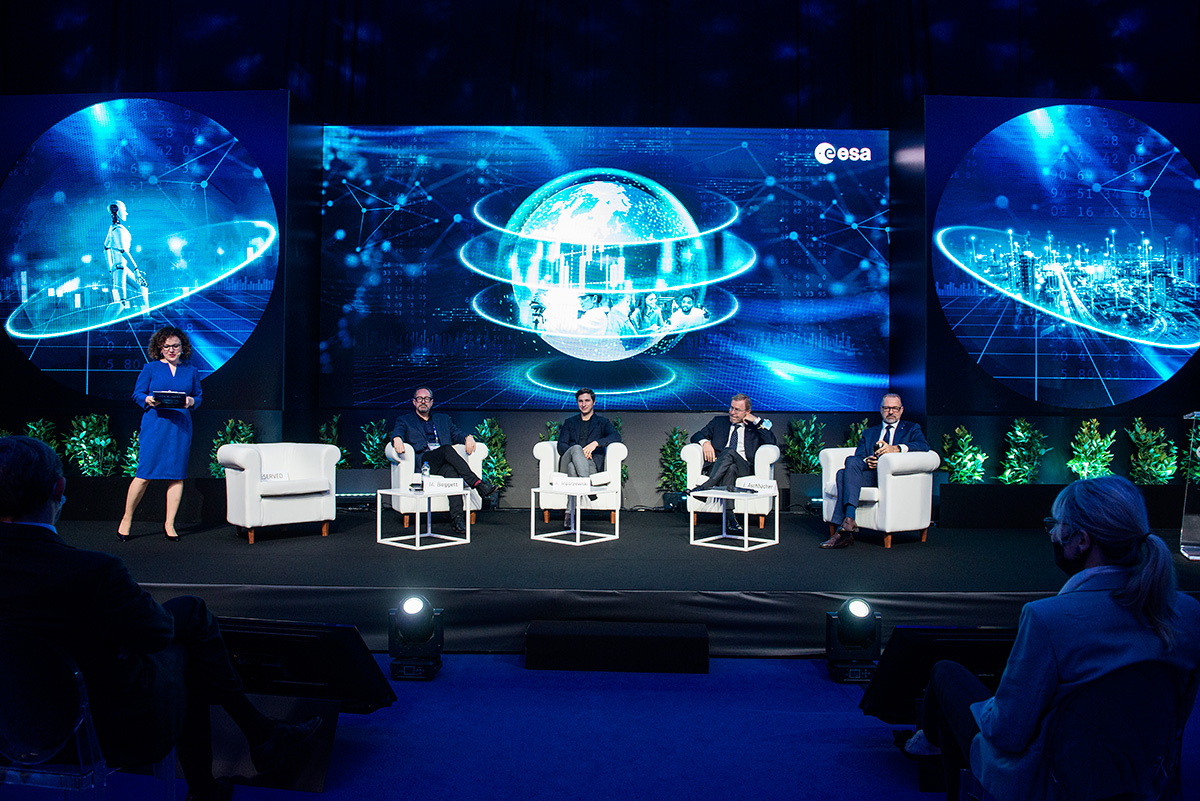
Replay the livestream of ESA’s ɸ-week, which brought together leading scientists and entrepreneurs from all over the world to discuss and brainstorm scientific and technological opportunities brought by the concept of Digital Twin Earth.

Over the course of the past three days, more than 1900 people virtually attended ɸ-week 2020 and participated in over 800 meetings online discussing how Earth observation data, along with in situ measurements, advanced models and artificial intelligence, can contribute to the concept of Digital Twin Earth – an interactive digital replica of our planet.

The event kicked off with an exciting announcement from ESA’s Director of Earth Observation Programmes, Josef Aschbacher, on quantum computing, updates on the ɸ-sat-1 mission and inspiring statements from ECMWF’S Director General, Florence Rabier, European Commission’s Deputy Director General for Defence Industry and Space, Pierre Delsaux, as well as Director General of DG CONNECT at the European Commission, Roberto Viola.

To know more: https://www.esa.int/Applications/Observing_the_Earth/Relive_Ph-week_2020

Watch the video on YouTube

ESA-CLAIRE conference: Space and AI

Call for contributions: Online conference “Space and AI”, September 4 
(with ECAI2020)

The ESA-CLAIRE Special Interest Group is organizing its first online 
conference on the use of artificial intelligence (AI) for applications 
in space technology. We are inviting presentations on topics concerning 
different AI methods (including, but not limited to, e.g., planning, 
machine learning) and different areas of space technology (including, 
but not limited to, e.g., space operations, earth observation).

Please send to spaceandai@uni.lu before July 31 an email containing the:

  • names and affiliations of authors
  • designated speaker
  • the title of your talk
  • a 200 word abstract
  • the desired length of your presentation (10 or 20 minutes including 
    questions)

Presentations of original unpublished work or of recently published work 
are both welcome. In the latter case, please include a reference to and 
a copy of the relevant publication.