ESA title

Strengthening InCubed’s role in commercial Earth observation

Commercialisation is universally recognised as essential for the future prosperity of all aspects of the European space sector, and Earth observation is no exception. The ESA InCubed programme, a co-funding initiative that helps entrepreneurs bring their innovative ideas to market, has enjoyed enormous success since the launch of its first activity in 2018 and continues to make a prodigious contribution to commercial Earth observation. The InCubed portfolio includes around 60 activities, with an impressive €63 million invested so far.

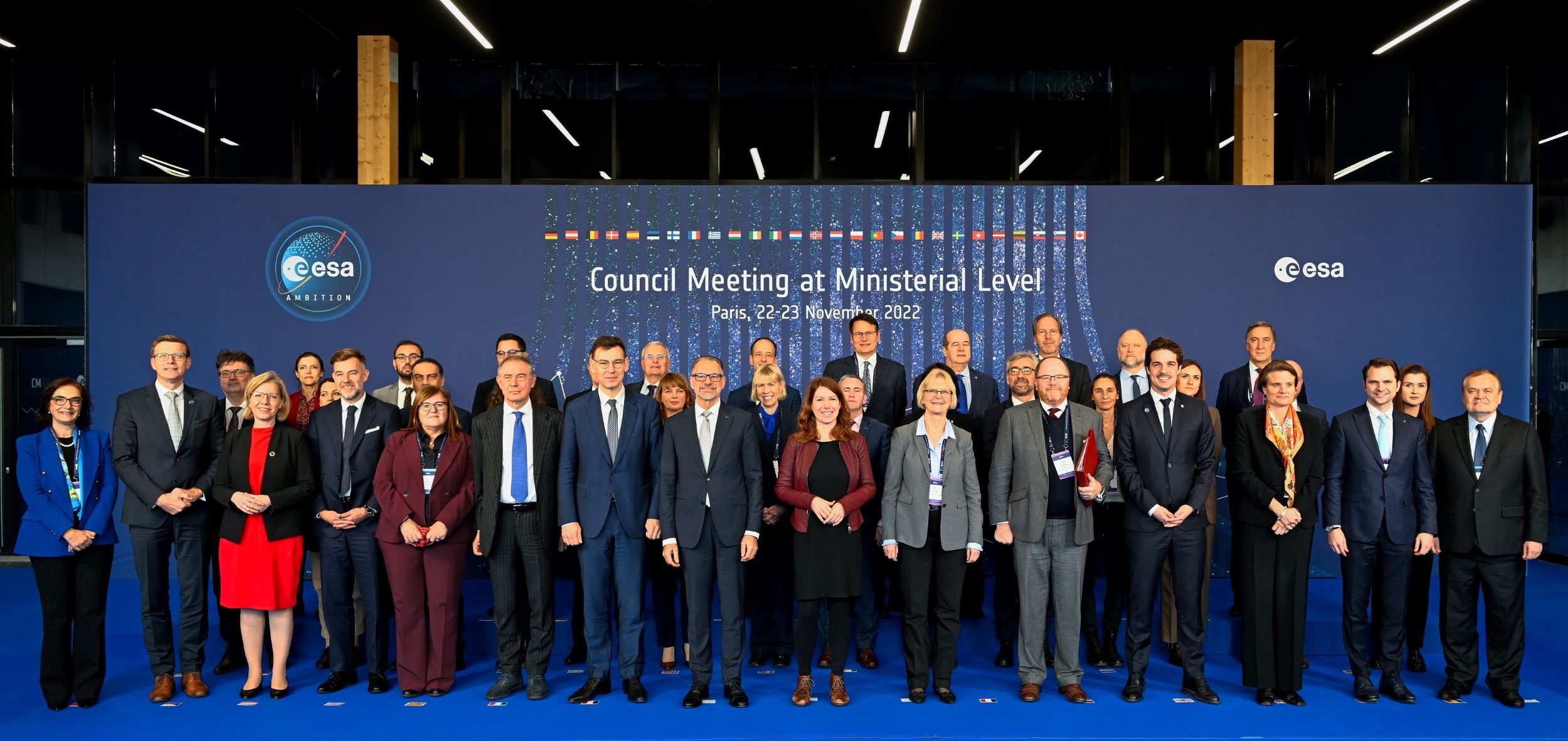
At the upcoming ESA Council at Ministerial Level, Member States will have the possibility to further empower InCubed in its far-reaching efforts to foster commercial innovation. The programme proposal makes the case for a wider remit, including a set of new ‘Invest Actions’ designed to help boost the European Earth observation economy and reinforce relationships with the private investor community.

Read the full article on www.esa.int.

Φ-lab@ESRIN extends its AI innovation push through collaboration with Leonardo Labs

The ESA Director of Earth Observation has signed a letter of intent with the Space Technologies Leonardo Lab (represented by Leonardo, Telespazio and e-GEOS) with a view to jointly developing space-based solutions for Earth observation (EO). After exploring areas of common interest, ESA Φ-lab and the Space Technologies Leonardo Lab will work together on projects that seek to boost the impact on the space sector of transformative technologies such as Artificial Intelligence, High-Performance Computing (HPC), quantum computing and Big Data.

The mission of Φ-lab@ESRIN is to accelerate the future of Earth observation through transformational innovation, thereby strengthening Europe’s world-leading competitiveness in the space sector. Partnerships are an essential building block of that mission, and Φ-lab has concluded a number of agreements with organisations, including venture capitalists, large and small companies and research centres, in order to increase the breadth and reach of its activities.

Two of the principal focus areas of innovation at Φ-lab are Artificial Intelligence (AI) and new computing paradigms like quantum, neuromorphic and edge computing, areas which are also central to the remit of a network of research laboratories set up by Italian company Leonardo. These Leonardo Labs include a Space Technologies research centre in Rome, run by Leonardo together with affiliates e-GEOS and Telespazio.

With such a degree of common interest between Φ-lab and the Space Technologies Leonardo Lab, the idea of a collaborative venture seemed like a natural fit. Leonardo Chief Technology and Innovation Officer Franco Ongaro explains: “The Leonardo Group has a consolidated relationship with ESA, further strengthened by the agreement signed with Φ-lab. The agreement with ESA allows us to pool our skills in areas such as AI, Big Data and quantum computing, combined with the computational capabilities of Leonardo’s HPC infrastructure, davinci-1, to increase the application of innovative methodologies in Earth observation and in the wider space context. The agreement is an expression of the vision of the company, which aims to strengthen the research activities carried out through the Leonardo Labs network – the company’s network of laboratories aimed at the digital sphere – and the consolidation of the open innovation activities that both represent determined factors of growth and competitiveness.”

“ESA Φ-lab is committed to pushing the boundaries of Earth Observation and how it is conceived, designed and implemented,” adds Simonetta Cheli, ESA Director of Earth observation. “The ultimate goal is to boost the innovation element of EO and thereby strengthen Europe’s world-leading competitiveness from both a scientific and commercial point of view. When we started interactions with what are now the Leonardo Labs, we immediately recognised synergies and complementarities that could greatly benefit this vision. We’re very pleased to have now reinforced our relationship with these major industry partners on topics of collaboration that are at the core of what we see as the future of EO.”

Details of the collaboration, which will also be able to draw on the wider Leonardo Labs network, are to be fleshed out as the parties continue their discussions. Nevertheless, a number of exciting topics of interest have already emerged. Neuromorphic Nets for example are AI architectures that better mimic the human brain and its neural networks in order to increase information processing efficiency and speed. Frugal Learning and Neural Ordinary Differential Equations are both types of AI model that are aimed at balancing computational performance and resources. All three of these areas potentially feed into the fourth topic, Onboard/Edge AI, which concerns the recent addition of AI processors to satellite payloads and the associated requirement for low-power/high performance computation. Last but certainly not least, Explainable/Trusted AI deals with the need to improve trust in Machine Learning models through predictability, robustness and explainability.

“The themes that we’ve jointly identified represent some of the most interesting development areas for the future of Earth observation,” comments Giuseppe Borghi, the Head of Φ-lab and the main ESA point of contact for the collaboration. “In exploring these transformative innovation areas together, Φ-lab and the Space Technologies Leonardo Lab intend to enhance the positive impact of such innovations on EO use cases. We expect the results of the partnership to then strengthen the growth of European EO, an ecosystem that is already generating world-leading solutions.”

Pierre Philippe Mathieu, the Head of the Φ-lab Explore Office, highlights the significance of the Leonardo Lab’s namesake: “AI is going through a global renaissance, and Leonardo Da Vinci was certainly one of the biggest icons of the Renaissance, bringing together as he did so many diverse fields of art and science with his creativity. This partnership between Leonardo Lab and ESA will strive to bring some of this Renaissance mindset to the inspiring world of AI4EO, gathering cross-disciplinary teams to develop innovative EO solutions which capitalise on the latest developments in AI techniques.”

To know more: ESA Φ-lab, Leonardo, Telespazio, e-GEOS

InCubed initiatives focus on data quality improvement and change monitoring

Three activities launched under co-funding from the ESA InCubed programme respond to customer needs for improved information quality and precise measurement of trends and variations by exploiting Earth observation (EO) assets. Targeted sectors include agri-food, environmental protection, mining and oil and gas.

NEO (NL): SINERGI service

Earth observation data from optical and Synthetic Aperture Radar (SAR) sensors provides a wealth of information for an ever-increasing number of business applications, but there is often a lack of verification of such data from other sources. Dutch company NEO is developing SINERGI, a novel service that improves reliability by combining EO-derived change detection with crowd-sourced data and publicly available information.

NEO Chief Operating Officer Jan Erik Wien explains: “SINERGI represents a major step forward in the fusion of satellite and non-space data. It uses semantic integration technologies to add validation and additional context to EO-based information services, enabling customers to make informed and data-driven decisions in their operations and helping them to meet their ESG [Environmental, Social and Governance] commitments. Typical Big Data pools feeding into SINERGI might include local government records, planning permission documents or even social media posts.”

The intended customer segments for the service vary from governing authorities in areas such as construction, forestry law enforcement and environmental inspection, to private-sector businesses like insurance companies. SINERGI has now completed its main development and is being piloted with customers in the fields of building-related information and invasive plant species in waterways.

ABACO (IT): FIbEO product

Another example of fusing EO and ground-based data is FIbEO, a product conceived by the ABACO group and aimed at the food production industry. “We recognised a gap in the market in terms of information availability for guaranteeing food quality,” says ABACO Project Manager Marco Bonfigli. “For a given crop, agricultural players need to understand current biomass status, have access to intelligent yield estimates and be able to cross-check compliance with specifications. The FIbEO platform will provide such aggregated insight through ML [Machine Learning] algorithms that draw on both satellite imagery and historical data, ultimately helping growers, consortia and control bodies to create trustworthy food supply chains.”

The first target segment for FIbEO is viniculture, with collaboration currently ongoing with growers in Italy’s Chianti region. The first release of the platform will enable wineries not only to predict output but also to identify dead vines in the field in near-real time.

TRE Altamira (IT): BulletInSAR service

Turning once again to the topic of change detection through SAR sensing, Copernicus Sentinel-1 and other radar imaging constellations enable mm-accurate displacements of the Earth’s surface to be measured from space, providing invaluable information to operators in sectors such as mining, energy, civil engineering and civil protection agencies. TRE Altamira already provides customers with remote sensing ground-deformation information on their assets of interest, but the satellite data stream currently requires significant human processing in order to produce actionable end-user reports.

Feedback from TRE Altamira’s clients identified the requirement for faster response times, greater capacity for monitoring multiple assets and supplementary details on measurement reliability. BulletInSAR is the company’s solution, a tool that will deliver timely, scalable deformation reports by adopting an ML-based unsupervised process to cut out the human bottleneck.

Alessandro Ferretti is the company’s CEO: “Innovation and pushing the technology envelope have always been key elements of TRE Altamira’s identity, and BulletInSAR is no exception. As development gets underway, we’re really pitching for a superior user experience, a solution that will deliver fully automated reports using a cloud-hosted interface with tailored results screening. Co-funding from InCubed is of course a powerful enabler for TRE Altamira, helping to propel us forward as we take market-driven SAR ground-displacement reporting to the next level.”

ESA InCubed Officer Piera di Vito continues the theme: “All three of these activities are a perfect fit for InCubed’s DNA: supporting innovative ideas that spot a commercial need for AI-driven, EO-sourced data and insight. We are proud to see and help sustain such a competitive and dynamic ecosystem in the Earth observation domain, and the fact that SINERGI, FIbEO and BulletInSAR are at different stages in their development amply demonstrates the end-to-end nurturing that InCubed provides, from concept through to market readiness.”

To know more: SINERGI, FIbEO, BulletInSAR

Copernicus Sentinel-1A image courtesy of ESA/DLR Microwaves and Radar Institute/GFZ/e-GEOS/INGV–ESA SEOM INSARAP study, CC BY-SA 3.0 IGO

ESA team achievement prize awarded to Φ-sat-1 team

The Φ-sat-1 team has been recognised in a major award that the Agency grants for achievements promoting the success and public reputation of ESA with the involvement of multiple Directorates. The team, which includes several researchers from Φ-lab, conceived, designed and built the Φ-sat-1 experiment to demonstrate Artificial Intelligence (AI) data processing capabilities onboard satellites.

Φ-sat-1 is the first ESA experiment exploring the potential of AI to improve the efficiency of sensor information streaming from Earth observation (EO) satellites. By filtering out clouds from optical imagery on the satellite itself, only the useful data is downlinked to ground stations, leading to significant bandwidth savings. The concept paves the way for a revolution in EO, as onboard AI processors will enable new services to be deployed quickly and cheaply by uploading applications directly to satellites.

The Peer Review Board for the ESA Team Achievement Award were impressed that the Φ-sat-1 team had transformed an idea into a completely new approach to onboard data processing in a very short time and under tight cost constraints, thanks to the combined efforts of members working across multiple ESA sites and Directorates.

“It was a stimulating experience for our researchers to be part of Φ-sat-1 and its pioneering development of AI-enabled EO satellites,” commented Pierre Philippe Mathieu, Head of the Explore Office. “Working fast in collaborative, interdisciplinary teams is part of our modus operandi at Φ-lab, and so it’s particularly pleasing that the review board recognised these aspects of the project.”

To know more: Φ-lab and Φ-sat

Irish minister commends InCubed contribution to entrepreneurial space sector

During a visit yesterday to ESA’s ESRIN establishment, the Irish National Delegation to ESA took a tour of Φ-lab and discussed the importance of the ESA InCubed programme. The day’s schedule also included the signing of a contract for the InCubed-supported PROTELUM activity.

The Irish Delegation was received yesterday at ESRIN by Simonetta Cheli, Director of Earth Observation Programmes and head of the establishment. The visitors were given a tour of the site’s facilities and participated in a number of sessions covering ESA’s Earth observation (EO) programmes, Ireland’s space policy and technical discussions with the Earth Observation Directorate management team.

The tour featured a visit to Φ-lab, where Division Head Giuseppe Borghi explained the lab’s mission and highlighted some of its flagship programmes. Φ-lab’s focus on transformational innovation in commercial EO was a key theme of the day, with a number of managers from Irish space-sector businesses among the guests. Several of these companies have benefited directly from Φ-lab support with the co-funding of development activities through InCubed.

“Ireland has a strong tradition of entrepreneurship in many sectors and, as our industry representatives showed during the visit to ESRIN, New Space is no exception,” commented Damien English TD, Irish Minister of State for Business, Employment and Retail. “We continue to be impressed by the work that Φ-lab and its InCubed programme are doing in nurturing private-sector Research and Development in Earth observation. It is enabling Irish companies to realise their potential by accelerating the commercialisation of their products and services, which is a key deliverable highlighted in Ireland’s National Space Strategy for Enterprise.”

One such InCubed initiative is the PROTELUM activity, which was launched yesterday at a signing ceremony during the visit. Developed by Dublin-based Davra, PROTELUM is a management tool for the ongoing compliance assessment and monitoring of mining sites. The platform will cover the entire mining life cycle and will enable operators and regulators to continually identify safety risks, both underground and at the surface. The solution will apply analytical methods to data from sources such as industrial Internet of Things (IoT) sensors, EO satellites and drones in order to provide actionable insights and predictive modelling.

County Cork’s Treemetrics also attended the event and gave a brief overview of its Satforcert product in one of the technical sessions. Satforcert uses EO-derived data in combination with Global Navigation Satellite Systems (GNSS) to create more efficient and transparent processes for sustainable forest management certification. Currently enjoying its second stint of InCubed co-funding, the product has successfully completed end-user validation and is now being expanded to include features related to forest carbon storage and credits.

Other InCubed-supported companies present during the visit included mBryonics, Skytek, TechWorks Marine and Icon Geo.

Simonetta Cheli added: “It has been a pleasure to welcome the Irish Delegation today in what has been an extremely fruitful exchange of ideas on the current status and future direction of European Earth observation. The contribution from industry partners has been particularly stimulating, with for example Davra and Treemetrics both demonstrating how commercial EO can contribute to sustainable development by providing vital monitoring tools. We are therefore delighted to support the PROTELUM and Satforcert initiatives through the ESA InCubed programme.”

To know more: ESA InCubed, Davra, Treemetrics, mBryonics, Skytek, TechWorks Marine, Icon Geo

InCubed to be represented at ESA’s Industry Space Days 2022

Michele Castorina, Head of the Φ-lab Invest Office, will talk about EO Market trends and present an overview of the ESA InCubed programme at the Industry Space Days (ISD) event, taking place on 28–29 September at ESA’s ESTEC establishment.

The ISD is an annual event organised by the ESA SME Office of the Directorate of Commercialisation, Industry and Procurement. Aimed at fostering cooperation between actors in the space sector, the gathering is free of charge and open to entities and investors from ESA Member States, Associate States, Cooperating States and the European Union. Participants can register here.

This year, Φ-lab’s Michele Castorina will be at the ISD to give attendees a flavour of the mission and activities of InCubed, including how companies, innovators and entrepreneurs can apply for co-funding of product/service development and commercialisation initiatives in the Earth observation sector. Michele will also be on hand for informal discussions with interested entities.


To know more: ISD 2022, ESA SME Office, InCubed

The AI effect: high-performing Sentinel-2 cloud mask goes global

After releasing its free and open-source cloud mask for Copernicus Sentinel-2 data, Estonian company KappaZeta is now working on enlarging the model from the Northern European summer season to year-round global coverage. Developed in conjunction with ESA Φ-lab, KappaMask is already outperforming similar approaches and uses Artificial Intelligence (AI) and active learning techniques to optimise automatic data labelling.

Although well established as a gold-standard provider of Earth observation (EO) insight, the data from Sentinel-2, like all optical satellite imagery, needs to have cloud and cloud-shadow areas identified and filtered out. Creating a cloud mask, effectively a stencil that removes unwanted data, is an essential step for virtually any EO application, and as ESA has shown with the Φ-sat-1 experiment, masking can be done effectively at source through onboard processing on the satellite. For Sentinel-2 users however, free, accurate and user-friendly cloud masks are currently few and far between. While masking is relatively simple when studying small areas, large stacks of imagery require automated pre-processing in order to provide timely, valid data to the user.

KappaZeta set out to provide an AI-powered, free-of-charge solution for Sentinel-2 data users worldwide. In an initiative funded by ESA Φ-lab, development commenced in 2020, with Phase 1 focused on Northern European summer-season conditions. Refining the mask was aided by the adoption of active learning, an approach which selects the highest impact samples for labelling. “We needed a reference dataset to train and test our model,” explains KappaZeta CEO Kaupo Voormansik. “Manual labelling of satellite imagery is a slow and expensive process, but as interest has grown in Deep Learning, the active learning methodology has proven to be a powerful tool for efficiently creating high-variety reference cloud masks using limited resources.”

Phase 1 was completed in August 2021, with the outcome published in a research paper and the initial version of KappaMask released to the public. The European model proved to be highly accurate and in fact performed better than comparable products, with particularly noteworthy results in the detection of cloud shadows and small fragmented clouds – a problematic area for some previous cloud masks.

The successful release of the Northern European summertime mask was followed by Phase 2, which aims to extend the model to the rest of the world over all seasons. This entails both improving the Phase-1 model architecture and obtaining a global reference dataset. For the latter, KappaZeta has used a combination of existing labelled datasets and its own labelling, the plan being to add 5000 newly segmented sub-tiles (each consisting of a 512 by 512 pixel area) to improve model accuracy. With an eye once again on efficient working, the team has picked the sub-tile locations based on Sentinel-2 data download statistics, thereby selecting according to user interest rather than aiming for a blanket global coverage.

Nicolas Longépé, Φ-lab data scientist and one of the ESA supervisors for KappaMask, recognises the effectiveness of the company’s research paradigm: “KappaZeta has used a smart approach for developing its cloud mask, with active learning and demand-based coverage helping to achieve the right trade-offs in terms of precision versus effort. Indeed the Phase-1 results have already shown KappaMask to be one of the most accurate free-to-use cloud masks, and once complete we fully expect the product to significantly enrich the analysis toolbox of Sentinel-2 data users.”

“We are also happy to support the project to see how KappaMask compares with other available solutions,” added Valentina Boccia of the ESA EO Ground Segment Department. “KappaZeta’s work convincingly illustrates how innovative AI techniques could be integrated into the mainstay of Sentinel-2 data processing.”

KappaMask is scheduled for release as a cloud-masking web service later this year. The reference dataset and source code will be freely available, and details of the model and the accuracy validation will be published in a forthcoming paper.

To know more: Sentinel-2, KappaZeta, Φ-lab Explore Office

ESA explores cognitive computing in space with FDL breakthrough experiments

In a series of world firsts, the Frontier Development Lab (FDL) programme in collaboration with ESA has achieved significant results in the field of Cognitive Cloud Computing in Space (3CS). In experiments on a D-Orbit InOrbit NOW satellite carrier mission, FDL has shown how a Machine Learning (ML) payload can reduce downlink latency, easily adapt to different optical instruments and be updated directly in space, while enabling fast information extraction and delivery to end users. FDL has also created an ML payload for third-party application hosting, launched on the latest D-Orbit mission in January.

It can take considerable time to fuse and extract actionable insights from space-derived data streams, which are often enormous. Just one image tile of Earth from ESA’s Sentinel-2 spacecraft, covering a 100 km by 100 km square, is 2.5 GB – the same size as a movie download. Flood information for emergency response is a prime example of where updated satellite-derived insights are indispensable for directing relief efforts, but bottlenecks in the downloading and analysis of images can lead to delays of several hours or even days in making actionable insights available.

Enter Cognitive Cloud Computing in Space (3CS), which has the potential to relieve such challenges by drawing on advances in federated Machine Learning combined with the provisioning of high-powered computational hardware in orbit. 3CS envisages large-scale intelligent swarm systems in space, where multiple spacecraft and instruments come together to empower Earth observation (EO), returning relevant and verified actionable insights to the ground within seconds. ESA is giving significant attention to 3CS and has already made inroads into understanding its onboard computing requirements through the Φ-sat concept, with the Φ-sat-1 experiment launching in 2020. ESA Discovery is funding 12 projects related to 3CS, and in the commercial EO environment, ESA InCubed is co-funding the AI-express (AIX) activity being developed by Planetek, D-Orbit and AIKO.

To prove the viability of some elements of the 3CS vision, FDL set up its NIO (Networked Intelligence in Orbit) experiments with funding and support from ESA Φ-lab. The NIO trials are based around the WorldFloods ML payload, which was developed by young data scientists in partnership with ESA Φ-lab in a 2019 FDL Europe sprint and subsequently published in Nature. The payload was launched in June of last year on the D-Orbit InOrbit NOW (ION) Wild Ride mission and runs on D-Orbit’s own Nebula cloud environment in tandem with Unibap’s SpaceCloud computer.

Firstly, in an emulation of onboard intelligent data processing, the WorldFloods payload took a pre-loaded Sentinel-2 tile of flood images and converted the pixel data to bounded polygons of flood areas. This resulted in a 10 000-fold reduction in data packet size, with the processed tile then rapidly downlinked and shown to perform comparably with conventionally produced flood maps.

Next, the WorldFloods ML payload was adapted to a different instrument. Instead of the high-resolution images from Sentinel-2, the ML payload received images from the Wild Ride onboard RGB D-Sense camera. Despite the fact that the camera has a fairly coarse resolution and was not designed for EO, the ML payload was successfully fine-tuned with only a few images and generated reasonably accurate vector maps of waterbodies, land and clouds. The maps were then downloaded in just 36 seconds.

Finally, the NIO team achieved another breakthrough by deploying an updated ML payload in orbit. Any ML pipeline needs to be maintained and refined, and so the ability to upload new model parameters or ‘weights’ to an onboard processor is a key component of any future 3CS infrastructure. The new model weights were uplinked to the D-Orbit/Unibap platform without a hitch, and subsequent functional testing demonstrated increased flood detection performance.

James Parr, whose company Trillium Technologies runs the FDL programme, sums up the value of the NIO results: “Taken together, these experiments give a tantalising glimpse of the promise of 3CS – how spacecraft working together with in-orbit cloud infrastructure can enable hybrid observation and adaptive space services. We have the potential to revolutionise how we respond to disasters, manage emissions and pollution, improve weather forecasts and foster next-gen space situational awareness.”

In a further NIO development, a set of advanced services tests has been funded by ESA for another D-Orbit ION satellite carrier. Launched in January, the Dashing Through the Stars mission includes a miniaturised hyperspectral camera, designed by research institution VTT. As part of the ESA-commissioned tests, FDL has created a customisable ML payload that allows third parties to upload and run Deep Learning models for onboard processing of the VTT camera images, delivering insights tailored to many different applications directly to the ground.

“The idea of intelligent, federated satellites operating in concert to provide insight faster and more accurately is a fundamental enabler for the future of EO, opening up new avenues for shaping the future of software-defined missions,” says Φ-lab data scientist Nicolas Longépé. “The NIO experiments on Wild Ride have served as a compelling proof of concept for 3CS, and with the launch of Dashing Through the Stars we’ll be able to see how access to such a system can be extended to new downstream applications.”

David Steenari, a data processing engineer from the ESA Directorate of Technology, Engineering and Quality, underlines the broad-based ESA support for Dashing Through the Stars: “The camera development, along with its integration on to the ION carrier and in-flight calibration, have been developed under a combination of GSTP and TDE funding. Coupling the imager to FDL’s ML payload will amply demonstrate exactly what tomorrow’s commercially accessible payloads will be able to deliver.”

To know more: Trillium, FDL Europe, SpaceCloud, WorldFloods

Access to Earth observation data to improve with AI-based I*STAR platform

Telespazio has signed a contract with the ESA InCubed programme to develop an innovative service for improving access to Earth observation data. Derived from artificial intelligence (AI) models, I*STAR will allow new user groups to request customised, smart data acquisitions from satellite constellations simply, efficiently and promptly.

The community of Earth observation players is growing and diversifying, as is the number of missions and business models in the sector. Users need a simple solution that recommends intelligent acquisitions of satellite data, while national and international space agencies could benefit from a platform which enables them to promote their missions to those same users. All stakeholders are naturally keen to reduce operational costs.

I*STAR is being developed to address these needs by Telespazio, a joint venture between Leonardo (67%) and Thales (33%). The as-a-service solution will provide one-click access for organisations to acquire EO data. Using Deep Learning and Machine Learning algorithms, I*STAR can model user preferences with regard to satellite platforms, sensors, areas of interest and types of products, ensuring that even non-specialist customers can make specific requests from missions without the need for direct support from space operations. Through the automation of data acquisition processes, human intervention is reduced and resources are freed up, giving rise to tangible cost savings.

A further advantage of the service will be the ability to improve response times for disaster relief, allowing authorities and civil protection entities to react more efficiently and effectively.

Marco Brancati is Telespazio’s Head of Innovation and Technical governance: “I*STAR introduces a brand new solution in the Earth observation ground segment –  the ability to request products or acquisitions according to user profiles while minimizing the need to know specific mission or to have operational skills. We’re very pleased and encouraged that the ESA InCubed programme has recognised our novel approach and given us the opportunity to bring I*STAR to market.”

“I*STAR is built on the idea that AI is a key enabler for new ways to exploit EO data,” commented Michele Castorina, Head of the Φ-lab Invest Office. “Improving usability and access for an ever-wider user community will help to invigorate commercial EO by providing a marketspace for both downstream and institutional operators.”

The I*STAR activity kicked off in April and is expected to hold its first major development review in October.

To know more: Telespazio, InCubed

Photo courtesy of Telespazio

Teach an Earth-observing satellite to know what it sees

For decades now Earth observation satellites have been monitoring our ever-changing home planet; the next step is to enable them to recognise what they see. The latest public challenge for the machine learning community from ESA’s Advanced Concepts Team is to train satellite software to identify features within the images it acquires – with the winning team getting the unique opportunity to load their solution to ESA’s OPS-SAT nanosatellite and test it in orbit.

Edge computing expert Gabriele Meoni of ESA’s Ф-lab at ESRIN, focused on Earth Observation – which has developed this challenge jointly with the ACT – explains: “ESA’s AI-equipped Ф-sat-1, aboard the Federated Satellite Systems (FSSCat) CubeSat, has already demonstrated the benefits of AI on-board – it is able to detect images filled with cloud cover and set these aside. With our new ‘OPS-SAT case’ competition, we seek to take this approach further. Participating teams receive 26 full-sized images acquired by the OPS-SAT CubeSat, which include small 200×200-pixel crops or ‘tiles’ identified with one of eight different classifications – Snow, Cloud, Natural, River, Mountain, Water, Agricultural, or Ice – with a total of ten examples of each type, representing a baseline for feature identification.”

The dataset for the challenge was collected in 2021 and specifically not published in order to keep the competition fair.

Read the full article on www.esa.int.

Photo courtesy of ESA, CC BY-SA 3.0 IGO