ESA title

HubCAP kicked-off as a new InCubed activity

HubCAP is a newly launched product developed by the Irish Icon Group with the support of ESA InCubed programme. This Open Source “Hands-Free Monitoring” platform for integration with existing workflows will answer the emerging needs from ELMS/CAP (environmental land management system/common agriculture policy), which represent a deep interest for the Icon Group.

HubCAP will be a highly flexible Application Platform for the agriculture and environmental sectors, based on Copernicus data and the SEN4CAP (Sentinels for Common Agriculture Policy) toolkit. It is developed by the Icon Group, a European leader in Earth imaging services and Ireland’s largest processor of imagery data.

The objective of this newly developed product is to align with a new paradigm in Land Cover and Use Determination using satellite imagery that has been enabled by the move from an artisanal process to an automated workflow-based provision of information. This will free up trained and capable technicians to provide analysis and information, rather than just simple image-based products, making the end user experience easier and more tailor-made.

The HubCAP service is conceived as three modules, each with a different starting point:

  1. IACS Module (integrated administration and control system)  – this will be the Paying Agency existing interface for CAP users, which they will customise to obtain HubCAP information
  2. EO Module – based upon results of other activities (SEN4CAP, DIAS (Data and Information Access Services))
  3. Bureau Module – based on a validated user concept and other activities (IACS)

The system is simple – because it includes a comprehensive API (Application Programming Interface) for monitoring via direct integration with existing administration systems, wide, verified, fully supported and very customer focused. It is wide thanks to an advanced dashboard for conducting bespoke ad-hoc local analyses, and it is verified since it offers and supports integrated ‘geo-photos’ and other forms of verification, where required.

Also, each classification ‘transaction’ is fully recorded and certified, showing the algorithm version and image sets used.

Elaine Doyle, Icon Group Product Manager said: “HubCAP is a robust and simple platform through which Government Agencies (especially CAP, non-CAP Paying Agencies and Environmental Agencies), and commercial users will be able to access the benefits of Sentinel data in a fully supported, legally recorded and compliant manner. We are very happy to count on ESA InCubed programme support to develop and commercialise it”.

Patrick Griffith, ESA Technical Officer, added: “The market of EO based CAP monitoring service capabilities is now really taking up pace. HubCAP comes with some innovative concepts and will lead to the enrichment and diversification of this key market for EO services.”

To know more: HubCAP Activity page, Icon Group, ESA InCubed programme

Living Planet Symposium 2022: time for abstracts

ESA’s next Living Planet Symposium is set to take place on 23–27 May 2022 in Bonn, Germany. In gearing up for this prestigious event, it’s now time to submit abstracts to ensure a much sought-after slot to present topics such as the latest scientific findings on our planet, novel Earth observing technologies and new opportunities emerging in the rapidly changing sector of Earth observation.

The deadline for abstract submission is 26 November 2021.

The Living Planet Symposia bring together scientists and researchers from all over the world to present and discuss the latest findings on Earth science and advances in Earth observation technologies. Moreover, these extraordinary events also offer unique forums for decision-makers to be better equipped with information, for partnerships to be forged and formalised, for space industries to join the conversation, for students to learn, and for all to explore the concepts of New Space such as the digital transformation and commercialisation.

Read the full article on www.esa.int

Deep Property by Ticinum Aerospace: InCubed support boosts an innovative AI-based service

Under the ESA InCubed programme, the Italian company Ticinum Aerospace will develop an innovative solution in the various areas of the insurance business (e.g. underwriting, risk modelling, etc.) by leveraging Deep Property. This AI-based service is capable to provide high-quality property data derived from geospatial sources in a cloud-based environment.

Ticinum Aerospace is a spinoff company from the University of Pavia, Italy, founded in 2014 by PhD students and PostDocs at the FabSpace Lab. Their expertise is in Artificial Intelligence (AI), machine learning, computer vision techniques and geospatial data processing.

Ticinum Aerospace aims to scale up a service called Deep Property using an AI-based approach to identify and record risk-relevant characteristics of individual buildings, such as the number of floors, the year of construction, the materials used, etc. This technology leverages big data derived from satellites, Earth observation techniques and other hi-tech sources (e.g. street-level images, smartphone pictures, etc.) to generate information layers that will reduce uncertainty in large-scale risk scenario evaluations.

The use of high-quality property data, generated in near-real-time, will enable insurance and risk modelling companies to enable their clients to improve risk mapping and more efficient property risk management. This will result in reduced losses and, at the same time, increasing competitiveness on the market. This concept originated in the risk estimation context, the generated property data, is coveted in other businesses, like real estate, energy, and smart cities.

The Deep Property development was kicked off in June 2021. All companies supported by the European Space Agency’s Investing in Industrial Innovation (InCubed) programme receive co-funding, technical and strategic support to further develop the service. Before the end of InCubed support in December 2022, Ticinum Aerospace primarily aims to develop new satellite data-based models, improving speed performances, and enlarging the pool of customers by better understanding their needs. During the development, Deep Property will be supported by two leading companies in the insurance context: Generali Global Corporate and Commercial, and Willis Tower Watson.

Gianni Cristian Iannelli, Ticinum Aerospace CEO and Head of Deep Property development team, said: “We are so glad for the opportunity InCubed programme is giving us, and we will do our best to meet the expectation that Deep Property is set to achieve success at global scale. For us as a group of engineers, ESA has always been a source of inspiration, and we are all excited to get their support in our next actions. Deep Property‘s mission is cutting the cost of risk uncertainties, especially against the effect of climate change. ESA will be a valuable partner in reaching our mission on making cities more resilient to natural disasters”.

Michele Castorina, ESA Technical Officer, also added: “More and more data from commercial Earth observation satellites is becoming available at prices that allows downstream market to flourish. Deep Property is exploiting the availability of this data through innovative machine learning algorithms for the insurance market, bringing value and innovation in a sector that is actively seeking to meet the challenges brought by the digital transformation. As ESA InCubed programme, we are more than happy to support this process. ”

To know more: Deep Property, Ticinum Aerospace, Willis Tower Watson, Willis Tower Watson Press Release, Generali, Generali Press Release

Φ-week 2021: looking back and looking ahead

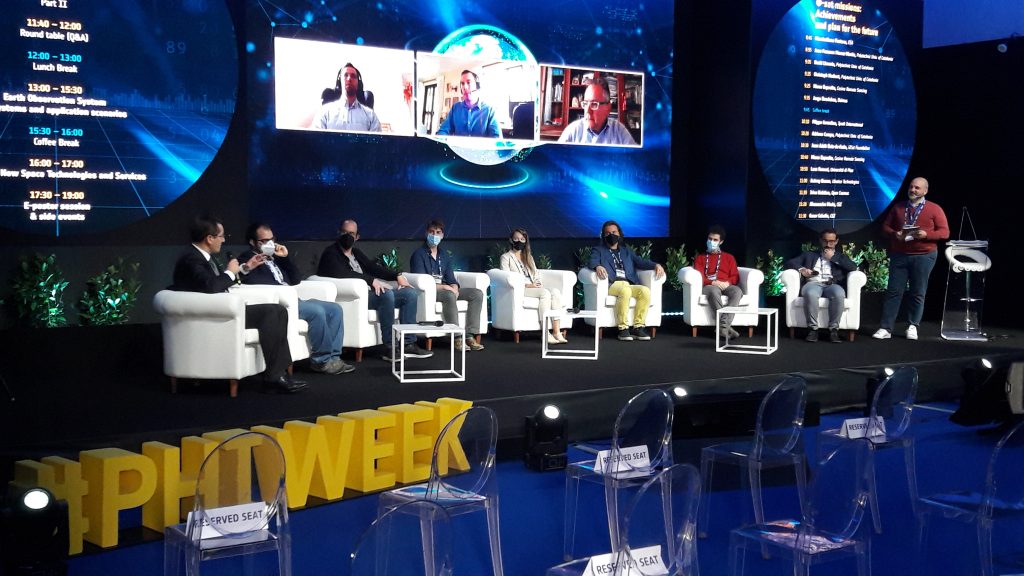
With thousands of online participants and more key sessions than ever before, Φ-week 2021 has proven to be a great success. As the curtain comes down on the event, now is a good time to reflect on its significance, take a quick tour of some of the hugely rich content, and think about outcomes and aspirations.

“Φ-week has established itself as the essential barometer for gauging the current status and future direction of EO innovation – and the 2021 edition is no exception. The coming together of industry, academia, private investors and major institutions fosters a unique exchange of ideas that invigorates our sector and propels us forward” – Giuseppe Borghi, Head of the Φ-lab and member of the Φ-week organising committee.

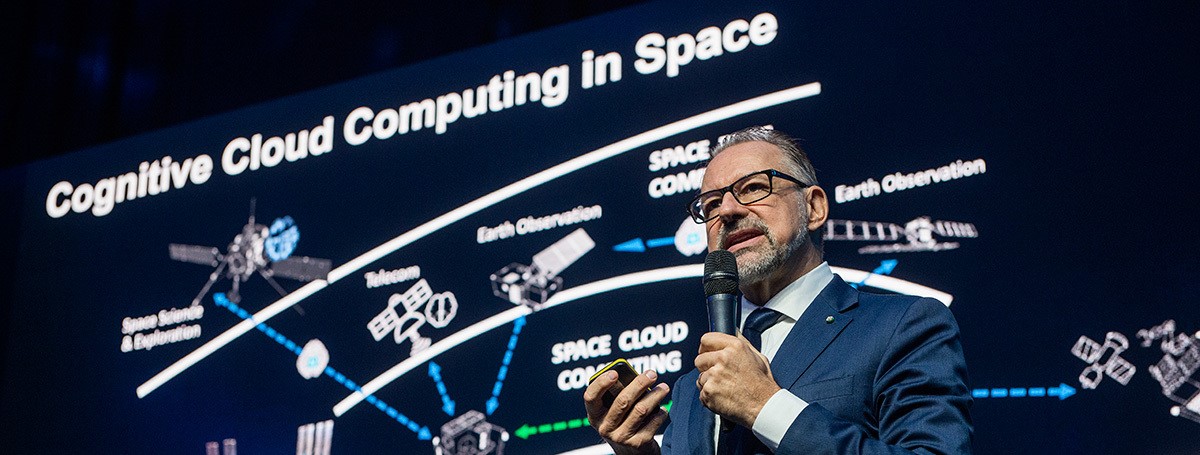
This year’s Φ-week got off to a tantalising start, with ESA Director General Josef Aschbacher announcing a competition – promising funding worth a total combined value of €1 million – in the areas of cognitive cloud computing in space. Innovators, researchers and entrepreneurs looking to submit their proposals for the competition will have found a great deal to stir the imagination from the 17 main sessions and around 190 supplementary items throughout the week. Indeed Artificial Intelligence (AI) and advanced computing paradigms were frequently recurring topics, with dedicated key sessions and a number of side events devoted to the application of this area to EO.

There were over 3,800 registered attendees from 91 countries at Φ-week 2021. For Ville Meskus, another organising committee member, the gathering provides a vital stimulus for the sector: “Φ-week gives our growing community a unique opportunity to get a very quick, yet comprehensive, snapshot of the latest developments in space and digital technologies, along with their potential and strengths and weaknesses. From my conversations with participants, I know they benefit hugely from the discussions and diversity of material presented, leaving them brimming with inspiration.”

The event this year, now in its fourth edition, was focused on EO New Space, and the theme was covered comprehensively over the course of the five days. Key sessions took up the subjects of enabling technologies, European access to space and accelerating New Space uptake. Smallsats were also discussed in detail, including both ESA SCOUT and other EO missions based on CubeSat platforms.

Many of the side events were hosted by external organisations. Running throughout the week, these specialised sessions delved into an extremely broad range of EO-related subjects, including the Space App Camp, Rapid Action on COVID19 with EO (RACE), data quality, intellectual property and AI for InsurTech, to name but a few.

The e-exhibitions and e-posters mirrored the themes of the key sessions, with around 150 organisations displaying their wares to the virtual audience. Attendees expressed their appreciation at the chance to network, chat via instant messaging and even organise individual video calls with exhibitors.

Looking to the future, Head of the Φ-lab Explore Office Pierre Philippe Mathieu hopes that Φ-week will also attract some new players to the scene, both in terms of careers and the funding competition: “As we’ve seen this week, space is an enthralling and promising career option, and in fact we have positions open in Φ-lab for Research Fellows to explore areas such as AI, the Internet of Things and Quantum Computing for EO. The competition announcement, which is particularly close to our hearts in Φ-lab, will undoubtedly engender a host of fresh ideas for exploring how cognitive cloud computing in space can help shape the new generation of software-defined missions. By next year’s Φ-week, we’ll know who has risen to the Director General’s challenge and whose concepts have won the sought-after funding.”

To know more: Φ-week, ideas.esa.int, jobs.esa.int, Contact Φ-lab

Calling all Sentinel-2 data users: volunteers required for product optimisation

As part of its InCubed co-funded MSCM initiative, Aerospacelab is currently looking for input from users of Sentinel-2 products in order to respond to market needs and improve downstream solutions.

The Multispectral Companion Mission (MSCM) is a constellation currently under development and aimed at supplementing Copernicus Earth observation products with small multispectral satellites, giving rise to high-quality, daily-coverage data sets which are strongly complementary to Sentinel-2 data. Belgian company Aerospacelab is developing and deploying an In-Orbit Demonstrator (IOD) for MSCM in an activity launched in February of this year and supported by ESA’s InCubed programme. The new data products emerging from MSCM, mainly characterised by a high temporal sampling rate, will allow current Sentinel-2-based models to be enhanced and will also unlock new use cases in the fields of precision agriculture, food security and environmental monitoring.

To ensure that its product planning is suitably matched to the needs of the user community, Aerospacelab is seeking collaboration from Sentinel-2 users. Participating entities will be asked to complete short surveys and tests covering topics such as image quality requirements and data access. The respondents will then have access to the resulting report, which will summarise current end-user market trends.

Taking part in this market information exercise will give organisations the opportunity to shape the path of the development activity, as the MSCM constellation will be tailored to the input received from key users. Participants will also have free access to data acquired during the Beta in-orbit testing phase.

To take part in the user group activities, please contact cecile.renaud@aerospacelab.be.

To know more: Aerospacelab, Sentinel-2

Working towards a Digital Twin of Earth

How can a digital replica of Earth help us understand our planet’s past, present and future? As part of the fourth edition of Φ-week taking place this week, a group of European scientists have put forward their ideas on the practical implementation of Digital Twins and the potential application areas for a Digital Twin Earth in the real world.

In the coming decades, population growth and human activities are expected to amplify the current pressures on critical resources such as fresh water and food, intensify the stress on land and marine ecosystems, as well as increase environmental pollution and its impacts on health and biodiversity.

These threats, comprising rising sea levels, increasing ocean acidification and more intense extreme events like floods and heatwaves, will need to be closely monitored, especially for our most vulnerable populations.

Read the full article on www.esa.int

Φ-week 2021: artificial intelligence and quantum computing

In three key sessions today, the Φ-week event dealt with the real nitty-gritty of advanced computational methods in Earth observation. Contributors discussed Artificial Intelligence for Earth Observation and Science (AI4EO and AI4SCIENCE), along with the emerging potential of quantum computing.

This morning’s session was entitled ‘AI4EO – Learning from Earth Observation Data to Understand Our Planet’. In summing up the role of Artificial Intelligence (AI), session co-chair Pierre Philippe Mathieu (Head of the Φ-lab Explore Office) gave a simple definition: “When AI meets Big Data from space – that’s where the magic happens.” He went on to describe just why AI is becoming such an essential tool: “Classical methods for information retrieval are now reaching their limits as a result of the volume and variety of data generated. AI offers a completely new view of acquired data, but also automates and accelerates data insight. One of the main aims of the session is to illustrate how to deliver the maximum value from the marriage of AI and EO data, while highlighting the limitations of the technology.”

Adopting AI methods is not without its challenges, and Φ-lab visiting professor Begüm Demir kicked off the session with a talk on the issues surrounding label noise in the training of Deep Learning algorithms. The presentation included proposals for identifying and reducing the impact of noisy image labels in land-cover annotations. The question of uncertainty was also taken up in talks on Machine Learning (ML) in climate change prediction and spatial mapping, while human development featured strongly in presentations on slum improvements, urban settlement and food security.

A feature of AI4EO which is central to the aims of the Φ-sat-1 experiment is filtering data directly on the satellite. A talk from Frontier Development Lab presented research on ML-driven unsupervised novelty detection which has, as Postdoctoral Research Fellow Valentina Zantedeschi from INRIA and University College London explained, already produced some promising results: “We’ve shown that unsupervised ML techniques improve the detection of relevant change while being less susceptible to noise than standard differencing methods. They also promise to reduce compute and memory requirements in terms of data processing and storage.”

“The broad range of talks has given an invaluable insight into the possibilities and hurdles associated with AI in EO,” commented the session’s other chair, ESA Research Fellow Rochelle Schneider. “I was particularly impressed by the diversity of our speakers and their shared passion for both innovation and pushing the boundaries of EO information processing.”

First up after lunch was the related topic of AI4SCIENCE. The session was chaired by ESA Open Science Platform Engineer Anca Anghelea: “AI is now showing enormous potential in helping us answer some fundamental geoscience questions. Machine Learning in particular can play a major role in rapid knowledge discovery by learning patterns and models from data.” With contributions from NASA and Microsoft as well as academia, the talks covered explainable AI and causal discovery, big Earth systems science, sustainability and seasonal forecasting.

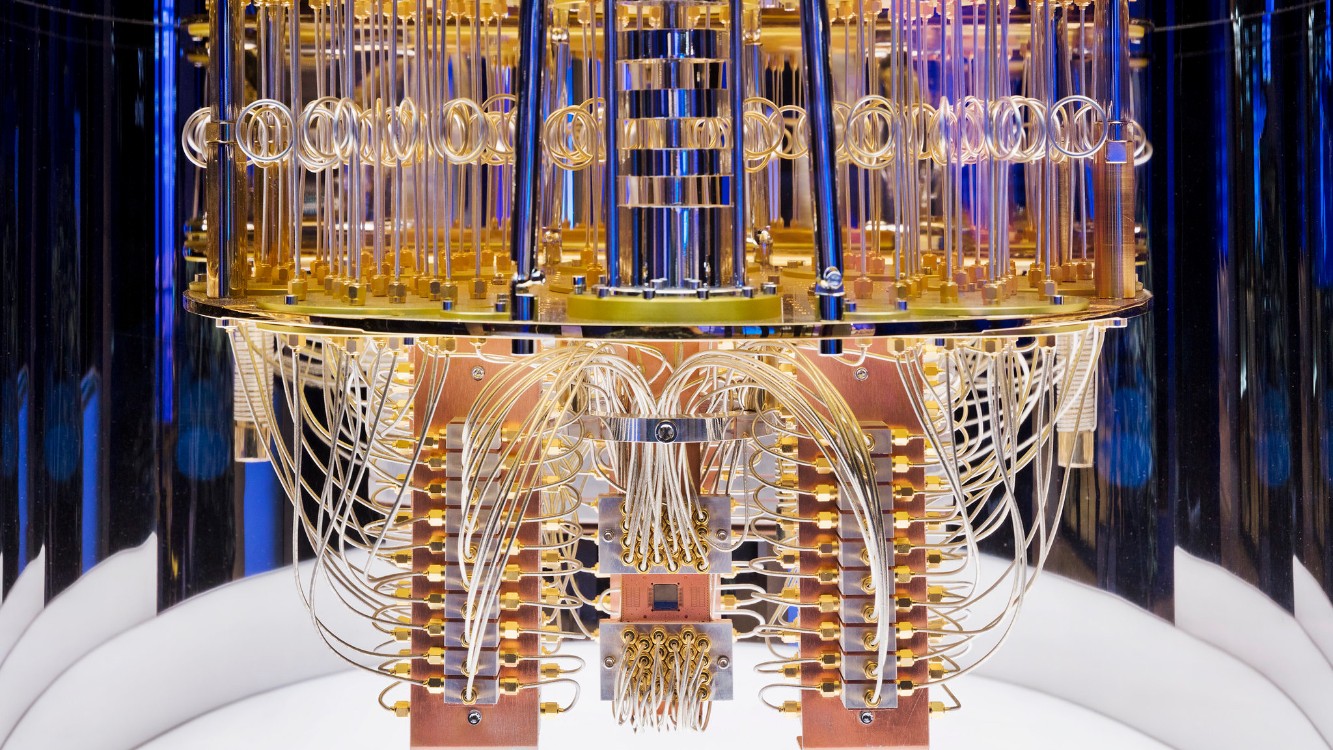
Recent advances in quantum computing are expected to unleash unprecedented computing power in the near future for processing and analysing EO data, for example from Synthetic-Aperture Radar (SAR), multispectral and hyperspectral imaging. Following the launch of ESA QC4EO at last year’s Φ-week, the final session of the group showcased some of the work carried out in this field in the last twelve months. CERN presented both the status of its research in quantum computing and the associated shared experiences for EO and particle physics. Other institutions taking part included ECMWF and Oxford University, with the latter’s Timothy Palmer presenting the imaginatively titled ‘Quantum Computing for Earth Observations: the Good, the Bad and the Noisy’.

“Quantum computing and artificial intelligence are new digital technologies that can be combined to get better EO products, and get them faster,” said ESA Digital Technologies Engineer and session facilitator Bertrand Le Saux. “We need to develop and harness the power of Quantum Machine Learning for EO Big Data analytics and, as today’s speakers have shown, we’re now establishing the groundwork for exploring how the unique potency of quantum computing can be used for extracting information from EO data.”

To know more: Φ-week, ESA AI4EO, ESA QC4EO


Photo Copyright: IBM Research

Putting the Earth observation into ‘the market perspective’

With a boom in the global market for Earth observation information and data products, participants at this year’s Φ-week conference have been digging deep into the ‘market perspective’. This important topic includes how to gain a better understanding of what governments, industry, the public and other users of Earth observation products and services need and expect to create value for society and the economy.

According to the latest report from the Geospatial Industry Outlook and Readiness Index, GeoBuiz, the Earth observation industry as a whole is estimated to have been worth almost US $58 billion in 2019, rising to almost US $76 billion in 2020. Moreover, it is thought that this steep rise merely marks the beginning of bigger things to come.

In addition, with respect to Europe industry, the 2021 survey published by the European Association of Remote Sensing Companies, EARSC, indicates that in 2020 there was a 24% growth in the number of companies associated with the Earth observation industry, as well as a 24% increase in revenue and a 17% rise in employees, compared to 2019.

Read the full article on www.esa.int

Φ-week 2021: Enabling EO Platforms session

Cloud-based EO platforms are an integral element for facilitating the paradigm change in Earth Observation (“bringing the algorithm to the data” et al.). Digital EO platforms are “Enablers” as they can boost the productivity of scientific/commercial users by simplifying the commonly encountered complex EO workflows. Key enabling elements include for example powerful and intuitive analytical operators, scalability of processing operations, efficient pixel-level data access and dynamic allocation of compute resources. The “Enabling EO Platforms” session at the 2021 ESA Φ-Week will showcase some key activities in the EO platforms domain.

First, openEO platform will be introduced by Alexander Jacob (EURAC). It is a highly federated, open-source EO analytics environment that abstracts underlying complexities when extracting value-added information from petabyte-scale data archives. The launch as an operational service will take place during this Φ-week with core deployments in multiple cloud environments (EODC/VSC4, CreoDIAS, TerraScope plus a data federation with SentinelHub/EuroDataCube).

Read the full article on www.eo4society.esa.int

Φ-week 2021: Φ-sat and the system-of-systems concept

Two key sessions on today’s Φ-week agenda painted a bright future for the proliferation of AI-backed Earth observation applications. With the latest news on the Φ-sat missions, together with examples showcasing the widening array of commercial and institutional use cases, the speakers presented a wealth of inspiring and thought-provoking material.

This morning’s session was devoted to the Φ-sat concept, covering both the achievements of the Φ-sat-1 experiment and the development of its next incarnation, Φ-sat-2. Launched just over a year ago, the Φ-sat-1 experiment was set up to study the impact of onboard Artificial Intelligence (AI) on EO data collection. The project developers Cosine Remote Sensing and the University of Pisa were on hand during the session to report on progress. Spain’s Universitat Politècnica de Catalunya was also well represented, with four talks on subjects such as soil moisture and sea-ice extent from the FSSCat cubesat-based mission, which is also hosting the Φ-sat-1 experiment.

Other Φ-sat-1 suppliers also took part, including Ubotica Technologies. The company presented results on a topic at the very heart of the Φ-sat-1 experiment mission: the Movidius Myriad 2 AI Accelerator. This chip is the engine behind the satellite’s data processing capabilities and, as Ubotica’s Chief Technology Officer Aubrey Dunne explained, its performance is being monitored continuously while in-flight: “Φ-sat-1 has provided unique in-flight performance data for the Myriad 2 AI accelerator, giving valuable insight into the reliability of the device and the accuracy of its AI computations. Results of in-flight self-test diagnostics from Φ-sat-1 indicate that Myriad 2 was 100% functional and performed all verifiable inference requests flawlessly, demonstrating the reliability and practicality of AI on cubesats and providing valuable flight heritage to support its integration into future AI-rich satellite missions.”

Φ-sat-2 is being developed by a group of entities across Europe. Lead company Open Cosmos was at the session to give an overview of the platform architecture and its key features. “The biggest challenge on this mission for us is facilitating all the needs of the AI applications that will be running onboard,” said Irina Babkina, Systems Team Lead for the Φ-sat-2 project at Open Cosmos. “What we’re working on at the moment to meet that challenge is ensuring that the application-enabling algorithms we’ll be running actually have the required performance.”

At the helm during the presentations and round-table discussion was ESA Φ-sat activity lead Massimiliano Pastena. He was impressed by the progress made on both mission variants: “Φ-sat-1 is generating useful data which is helping to demonstrate the worth of onboard AI in EO satellites. This is laying the foundation for the parallel development of Φ-sat-2, which is scheduled for launch next year. As we’ve heard today, the power to upload, deploy and update AI applications in orbit, almost as simply as we do on our smartphones, will ensure that Φ-sat-2 becomes the benchmark for the next generation of flexible, user-oriented nanosatellites.”

The theme of targeting user needs continued in the afternoon with the System of Systems session. Giuseppe Ottavianelli, Head of ESA’s Earth Observation Applications Section and one of the session chairs, outlined the scope of the gathering: “The system-of-systems concept is about the possibilities deriving from the synergy between publicly-funded EO missions and private commercial assets. With global coverage and the long-term availability of calibrated data, public missions such as the Copernicus Sentinels form a solid basis for commercial investments in terms of both the space segment and downstream value-adding industry, giving rise to a host of customer-tailored applications.”

The session provided a fitting exposition of the breadth of such applications. Alongside the more established areas of agriculture, forestry and coastal monitoring, the speakers also addressed  infrastructure asset management, urban planning and even the use of Very High Resolution (VHR) data for security applications. One talk in particular, given by ESA CHIME Operations Manager Antonio Gabriele, highlighted the potential gains from public-private EO initiatives and explored the idea of a hybrid constellation of CHIME and VHR smallsats, along with the applications that could result from this combined fleet.

Commenting on this and the other talks in the session, Head of the ESA EO System Architect Office Antonio Ciccolella was upbeat about the prospects for continuing growth in the sector: “The CHIME+VHR hybrid idea shows just how the system-of-systems concept could bring significant benefits for society at large. Underpinned by technologies such as AI, the Internet of Things and Blockchains, we expect the emerging abundance of new hardware and applications to deliver what could be called the Future Earth Intelligence System. The presentation from Rafael Guzman of Satlantis is another concrete example of private-sector investment in space, complementing Copernicus observations and using Sentinel data as a reference for the endeavour.”

To know more: Φ-week,  Φ-sat, Copernicus Sentinels, CHIME


Photo Copyright: ESA