ESA title

New opportunities for industrial PhDs in partnership with ESA to work on game-changing Earth Observation topics

As part of the Italian National PhD in Earth Observation scheme, coordinated by Sapienza University of Rome, ESA is supporting 10 industrial research fellowships in trailblazing areas such as data fusion, edge computing and artificial intelligence (AI). Driven by the need to nurture new talent in Italy to create the Earth observation experts of tomorrow, the PhDs will involve the analysis and use of Earth observation data, and in particular Italian capabilities such as the IRIDE constellation, across a variety of applications, ranging from crisis management to climate change and agriculture. Each fellowship will include a six-month placement within Φ-lab at ESA’s ESRIN establishment near Rome.

Earth observation (EO) is key to monitoring our planet and guiding our society towards a more sustainable future. While the demand for space-based information to address global challenges such as climate change is rapidly growing, it is increasingly difficult to find the right talent for combining the necessary cross-disciplinary skills, including the understanding of physics, geoinformation processing, AI and computer science. EO scientists need to be able to draw on these fields in order to turn Big Data into new, sound scientific knowledge and information services.

In recognition of the importance of EO and the need to develop a skilled workforce to make the most of existing and upcoming Italian EO capabilities, the Italian University and Research Ministry (MUR) has recently supported the creation of the National PhD in Earth Observation (DNOT). DNOT aims to provide training and integrated skills for young researchers in EO, geomatics and geoinformation in response to the need to train professionals with transverse and integrated capabilities in EO and computer science, along with specific application, administrative and legal skills.

Tomorrow’s EO workforce will need to enhance the already existing services and design new ones, in close collaboration with actual and potential users of EO data. To this end, DNOT is fully integrated with the Copernicus Academy and offers a scheme to enhance knowledge through real hands-on experience with selected industrial partners.

ESA is one such partner, and together with the DNOT network has set up fellowships for 10 PhD researchers. The fellowships will be based at various universities across Italy, comprising Sapienza University of Rome, IUSS di Pavia, Università di Bologna, Università di Firenze, Università di Napoli Federico II, Università di Padova and Università di Pavia. The aim is to address a variety of EO applications ranging from data fusion to edge computing and new data products to support the understanding and better management of natural disasters, climate change, water cycles, landscape evolution and farming. A particular focus will be on using the upcoming IRIDE constellation to create new synergistic products with existing European EO assets such as Copernicus.

The cohort of researchers will also have the opportunity to spend six months at ESA Φ-lab over the course of their PhD, in order to bring new experiences and technologies like AI into the heart of their research. Φ-lab is a powerful enabler of innovation and groundbreaking research in Earth observation, and its areas of interest marry well with the topics chosen for these 10 positions.

Applications are encouraged from graduates in mathematics, statistics, physics, chemistry, geosciences, engineering and computer science who are keen to help shape the future of Earth observation. Details can be found on the fellowship call webpage (reference D – DM117).

To know more: Φ-lab, DNOT

Photo courtesy of ESA/NASA

Φ-lab and UNICEF enhance their collaboration with new resources for global child connectivity project

Continuing its joint initiatives with ESA Φ-lab, UNICEF is appointing two researchers to work on a project that forms part of the UN Secretary-General’s Digital Cooperation Roadmap. The project maps current access to electricity and the Internet for schools around the world in support of an ambitious UNICEF target to provide connectivity for every child by 2030.

Around half of the world’s schools have no Internet access, and 1.3 billion children do not have connectivity at home. The result for those young people is fewer opportunities to learn and fulfil their potential.

In an effort to close this digital divide, UNICEF and the International Telecommunication Union have created Giga, a global initiative aimed at connecting every school to the Internet by 2030. Giga recognises that connecting schools enables children to develop digital skills and access online learning, while also providing wider connectivity benefits for businesses and services in the surrounding communities.

A crucial step in reaching Giga’s goal is to understand the current connectivity status, but many governments do not have comprehensive information on the locations of schools in their country or whether schools have electricity or Internet access. With its expertise in interpreting satellite-derived data through artificial intelligence, ESA Φ-lab is extremely well placed to offer a helping hand in this area and already has experience of fruitful collaboration with UNICEF in research on predicting dengue fever outbreaks.

In a project with Giga that profiles school catchment areas to predict grid connectivity, Φ-lab is employing techniques such as Support Vector Machines and Multi-Modal Deep Learning Networks to analyse both Earth observation and terrestrial datasets. “We set out to answer a number of questions that would improve today’s information and deliver comprehensive, credible data on schools around the world,” explains Φ-lab researcher Casper Fibaek. “We’ve already used our models to validate current UNICEF data on school coordinates and have identified 65 000 incorrect locations in Brazil, for instance. We’re now looking at estimating the student count per school by combining catchment-area modelling with population maps.”

The project is about to benefit from two new colleagues, both visiting researchers from UNICEF. The first appointee is Abi Riley, who after completing a Masters degree in mathematics in the UK is currently working on a PhD on spatio-temporal methods for environmental health modelling. The second researcher will be announced in the near future. Abi and her colleague will be working on measuring the likelihood of schools being connected to the Internet and mains electricity network through such diverse sources as NASA’s VIIRS Nighttime Imagery, Copernicus Sentinel 2 and auxiliary data on mobile phone usage.

“Abi will be most welcome in our very collaborative and catalytic research space,” added Φ-lab AI Applications Lead Rochelle Schneider, who also led the multi-award-winning dengue project with UNICEF. “I’m sure both she and the second appointee will make a remarkable contribution to a project that demonstrates Φ-lab’s continuing relationship with the UN for the benefit of disadvantaged communities.”

Dohyung Kim, Giga’s Lead Data Scientist, stressed the significance of having comprehensive data: “In our mission to connect every child to the internet by 2030, having actionable insights on Internet access is a fundamental component. This enriched data perspective allows us to understand and address the challenges faced by different schools and regions. We’re excited to continue our collaboration with our friends at ESA Φ-lab on this initiative. Furthermore, I am inspired by the fact that these two research posts reinforce our commitment to promoting opportunities for young scientists worldwide.”

To know more: Φ-lab, UNICEFGiga, UN Digital Cooperation Roadmap

Photo courtesy of Giga

World breakthrough in onboard AI model training presented by Φ-lab at IGARSS

At the International Geoscience and Remote Sensing Symposium (IGARSS) on 21 July, ESA Φ-lab presented the results of groundbreaking research in artificial intelligence (AI) aboard Earth observation satellites. Carried out by Oxford University and Trillium Technologies in collaboration with Φ-lab, the research successfully trained a cloud-detection Machine Learning model while in flight on a D-Orbit ION mission.

ESA has given considerable attention in recent years to Cognitive Cloud Computing in Space (3CS), with such initiatives as the Φsat missions and the 3CS Call for Ideas helping to push the boundaries of enabling ever-increasing computational power onboard Earth observation (EO) satellites. The D-Orbit Dashing Through the Stars mission was launched in January 2022 and included a number of service tests funded by ESA. Among these was a customisable Machine Learning (ML) payload which allows models to be uploaded, updated and run directly on the satellite.

Despite the models running on the satellite, model training would normally take place on the ground due to the computational load and the enormous datasets required. In a world first however, Trillium Technologies and Oxford University’s Department of Computer Science have trained one such model directly onboard during the D-Orbit mission. This development has momentous implications for remote sensing, not only in Earth Observation but also in deep space exploration, as onboard training allows models to adapt autonomously to both changing conditions in space and sensor calibration drift. This is all the more important when the communication channel between the spacecraft and ground is limited due to distance and/or bandwidth.

To overcome the resource constraints of onboard training for ML models, the research group adopted an innovative approach involving an initial ML model known as RaVAEn. This model specialises in efficiently compressing EO images to just a few kilobytes, reducing the data to a ‘latent space’ representation. The key advantage of this methodology lies in the ease with which the constrained satellite hardware can handle the compact latent space. Unlike the original large and data-intensive imagery, the compressed representation is significantly smaller and more manageable.

Illustration of the training data for the model (left) and the resulting predictions from new data (right). Detected clouds are indicated with red dots.

The full paper on the research will be published soon at ieeeigarss.org.

“RaVAEn first compresses the large image files into a vector of 128 numbers, keeping only the most relevant and informative content,” explains Vít Růžička, the project lead for Oxford University and a former Φ-lab visiting researcher. “By employing RaVAEn to compress the images, a second tiny ML model can work with the compressed latent space and perform onboard training and cloud detection without overwhelming the satellite’s resources.”

Following this initial demonstration of onboard training capabilities with base-level cloud detection, model development will now continue towards more challenging feature detection.

ESA data scientist Nicolas Longépé is leading the research on edge computing at Φ-lab and gave a talk on the results at IGARSS: “This activity received an enthusiastic response at the symposium, with the success of the RaVAEn compression capabilities opening avenues for rapid, computationally efficient training of models directly on the satellite. The results are also significant in terms of the federation aspect of 3CS, as we envisage the enticing prospect of intelligent, autonomous constellations with compressed but reliable data being exchanged within the fleet.”

To know more: ESA Φ-lab, ESA InCubed, IGARSS, Trillium Technologies, Oxford University Computer Science

Main image courtesy of D-Orbit. Copernicus Sentinel-2 imagery courtesy of ESA and processed by Vít Růžička

Earth Systems Predictability forum provides strategic insights on how disruptive innovations help steward our planet

The Earth Systems Predictability (ESP) Forum took place in May with support and major contributions from ESA Φ-lab. The event saw academics, institutional representatives and industry specialists come together to explore how the combination of Earth observation (EO) and artificial intelligence (AI) can inform data-driven decision-making on climate issues. The initial findings of the forum have now been published.

“The impact of our failure to care for our planet is now self-evident on a daily basis, underscoring the fundamental role of Earth observation in increasing awareness, helping to forecast trends and guiding policy on the climate crisis. AI can and does assist us with the considerable computational challenges associated with modelling Earth systems. Creating a sustained dialogue between experts in their respective fields will undoubtedly contribute to scaling and developing our predictive capabilities, and the ESP Forum was an exciting and valuable step towards that goal.” – Jonathan Bamber, Professor of Glaciology and Earth Observation at the University of Bristol and member of the ESA Advisory Committee for Earth Observation (ACEO).

The current catastrophic wildfires and extreme weather in southern Europe have sparked renewed discussions on the need for climate mitigation. Clearly climate change resilience planning and rapid disaster response will continue to be a central focus for society over the coming decades, driving the need for increasingly reliable and comprehensive Earth systems predictability. Initiatives like ESA’s Digital Twin Earth will provide a progressively more accurate picture of natural and human activity on our planet, but a gap exists between the knowledge gained from such models and the necessary action that should result from that knowledge.

Organised by Trillium Technologies in partnership with ESA Φ-lab and Oxford University, the ESP Forum was set up to build a cohesive vision on Earth systems predictability between data scientists, data users and decision makers. In a series of preliminary and main workshops, an interdisciplinary cohort came together to define the opportunities and challenges of developing ESP through the twin enablers of AI and satellite-derived data. The subject matter was divided into the three principal themes of Twinning and Simulation, Integrating Knowledge and Decision Intelligence, with participants at each session tasked with examining the practical steps required to establish and maintain a functioning and trusted ESP system.

The preliminary conclusions of the gathering have now been published. For the Twinning and Simulation theme, the forum emphasised that ESP technologies that combine EO data, fast simulations and robust machine learning models have a great potential for enhancing decision making at all levels, but these technologies must be deployed carefully to encourage adoption, scaling and impact. EO tools need to be accessible to a broad range of stakeholders, including for instance local populations and indigenous peoples, who in turn must be involved in creating shared knowledge tools. A holistic approach towards the simulation of interconnected systems will allow users to visualise consequences and outcomes more fully.

The Integrating Knowledge group discussed the role of Foundation Models and Large Language Models (LLMs), which offer a tremendous opportunity to build accessible and democratic expert systems for ESP. A key recommendation was to build LLMs that are continuously updated concept engines, with continuous learning/unlearning as a driver. The subject of stakeholders was also addressed by this group, including the proposal that semantic layers should be investigated so that jargon is not a barrier to communication, together with creating a broad advisory committee for knowledge systems in order to engage marginalised groups and vulnerable populations.

Under the Decision Intelligence theme, the participants stressed that AI should be seen as a joint decision-making paradigm, although integrating humans into hugely complex, multivariate and rapid decision scenarios will require innovation in how we interface with AI-derived recommendations. Disciplines from ESG (Environment, Social and Governance) best practice may be usefully applied to AI4EO, but the nuanced considerations that these areas require have so far been beyond the capabilities of machines. However, the technology is improving and therefore so is the ethical reach of the decisions that AI can support. The group concluded that ultimately, extending this moral remit to the decisions society needs to make to avoid the worst effects of climate change is where the greatest potential goal for AI4EO lies.

The full provisional findings are detailed on the forum webpage.

Kirsten Dunlop, CEO of Climate-KIC and keynote speaker for the Integrating Knowledge theme, emphasised the importance of the timing of the event and its findings: “We are at a critical juncture in terms of on the one hand, the rapid rate of global temperature rises and on the other, the exponential increase in data and knowledge available for decision making. With its broad spectrum of expert contributors, the ESP Forum was able to identify both the potential and the pitfalls of Earth system models for raising awareness and enabling more effective decision making in climate action.”

“Given our remit of transformational innovation and advanced computational research in Earth observation, the ESP Forum was a natural fit for us,” commented Head of ESA Φ-lab Giuseppe Borghi. “We were delighted to have contributed to the event and the discussions, and I’m convinced that the conclusions and directions to be set out in the final report will provide the building blocks for a true symbiosis of Earth system prediction and fact-based climate policy making.”

To know more: ESA Φ-lab, Trillium Technologies, Oxford University, ESP Forum

Images courtesy of Trillium Technologies

Φ-lab contributes to Earth observation education at ESA-NASA training week

The Trans-Atlantic Training course (TAT 2023) took place in the Czech Republic from 27 June to 1 July and included presentations and tutorials from current and past Φ-labbers. Organised by ESA, NASA and the Charles University in Prague, the course was aimed at educating early-career scientists and post-graduate students on remote sensing for environmental monitoring and modelling.

TAT has been running since 2013 with the objective of providing training activities for young scientists in the field of Earth observation (EO), with a particular emphasis on remote sensing of land-cover change and ecosystem dynamics. The forum shares and discusses advanced space research through a series of workshops, with this year’s edition dedicated to Synthetic Aperture Radar (SAR), passive optical sensing and lidar for forestry, agriculture and hydrology.

Attendees from 18 countries took part and were able to gain a detailed picture of the state of the art in satellite-derived environmental measurement and prediction. The week was split between the cities of Prague and Brno and included insight from a number of global experts in the field.

The expert input included a significant contribution from ESA’s Earth Observation Programme Directorate. Scientific Coordinator Francesco Sarti was part of the TAT organising committee and kicked off Day 1 with an outline of the Agency’s current and forthcoming EO missions. Next was a session introducing Φ-lab and its activities, with talks from Digital Technologies Engineer Bertrand Le Saux, InCubed Officer Albin Lacroix and other Φ-labbers. The session began with a comprehensive overview of how the Explore Office’s research is transforming Earth observation through the application of artificial intelligence, quantum machine learning and other computational methodologies. This was followed by a presentation on the scope, benefits and successes of the ESA InCubed programme.

Day 2 featured a key lecture on applying SAR data time series to forest monitoring. Given by former Φ-lab visiting researcher Daniel Paluba, the workshop was largely based around work carried out at ESA and included two practical sessions, covering topics such as processing Copernicus Sentinel data and comparing Classical and Automatic Machine Learning approaches. This and the other ESA-related presentations were very well-received by the course attendees, with the Φ-lab sessions in particular giving a glimpse into real-world opportunities in EO research and commerce.

“I think it’s crucial that Φ-lab contributes to educational events such as TAT,” Bertrand Le Saux reflects. “Not only is it a pleasure for us to share details of our research and industry support with such an enthusiastic and energetic audience, but I also feel we are helping to plant the seeds for the EO scientists and entrepreneurs of tomorrow.”

To know more: ESA Φ-lab, ESA InCubed, TAT on eo4society, Copernicus Sentinel missions

InCubed co-funded SaferPlaces platform maps aftermath of Emilia-Romagna floods

The Italian region of Emilia-Romagna was devastated by severe floods in May 2023, claiming lives and displacing thousands of people, resulting in an estimated €8.8 billion in damages. With the region still grappling with the aftermath, satellites have been instrumental in assessing the damages of the affected areas.

Between 16-18 May 2023, 350 million cubic metres of water, equivalent to six months’ worth of rain, fell within 36 hours across Emilia-Romagna, one of Italy’s most important agricultural regions. The heavy rain led to the overflow of 23 rivers across the region, affecting 100 municipalities and triggering more than 400 landslides, which in turn damaged and closed off hundreds of roads.

Read the full article on www.esa.int.

Φ-lab-WMF AI4EO competition inspires European New-Space start-ups to rise to the challenge

At a recent award ceremony, Φ-lab announced the four winners of the AI4EO Call, a competition launched in conjunction with the We Make Future event. The top entries received a range of prizes, including an all-expense-paid trip to the ESA EO Commercialisation Forum in October.

As a seed bed for innovation in commercial Earth observation (EO), ESA Φ-lab actively promotes and encourages ideas from start-ups and entrepreneurs. We Make Future (WMF) is the largest digital and social innovation festival in Southern Europe, and so provides an ideal forum for Φ-lab to interface with today’s and tomorrow’s success stories in the space sector. In fact ESA has enjoyed a major presence at the gathering since 2020, and this year’s edition in Rimini in Italy featured a popular ESA booth with exhibits that included activities, products and mock-ups from Φ-lab. The multitude of visitors to the booth comprised enthusiasts, start-ups and companies among others, with each taking the opportunity to interact with Φ-labbers and other ESA representatives.

A notable attraction at this year’s event was the AI4EO Call, a joint initiative of Φ-lab and the organisers of WMF. The competition concerned applications of artificial intelligence (AI) and data processing in aerospace and EO and aimed to reaffirm the value of these sectors in international development and the protection of our planet. Entries were assessed by a panel consisting of ESA and industry representatives, based on criteria including project feasibility, degree of innovation, competitive positioning and potential for further development.

Sixteen of the start-ups were shortlisted and invited to WMF to pitch their proposals to the panel. At a dedicated ceremony in the ESA booth, Φ-lab AI Ecosystem Manager Sabrina Ricci announced the four winning applications:

  • FlyPix AI, a geospatial platform that extracts insights from satellite and drone imagery, enabling customers to detect and segment objects of interest, identify their characteristics and monitor changes and anomalies over time
  • SaferPlaces, an AI-based digital twin solution that uses satellite and climate data to deliver flood risk intelligence for urban environments
  • Terroir from Space, a service for the wine industry that both detects unexploited planting sites and monitors existing vineyards through AI processing of EO data
  • Latitudo 40, an analysis engine that draws on Deep Learning algorithms to provide customers with satellite-derived information on topics such as land use, carbon sequestration and coastline erosion

The first-prize winners, FlyPix, won a trip to the ESA EO Commercialisation Forum in October, where they will participate at an ideas-pitch session with private investors. Other prizes for the runners-up included access to business and technical coaching on EO and a subscription to the Sentinel Data Hub.

“We’re truly grateful to have had the opportunity to take part in the AI4EO competition at WMF 2023 and were overjoyed to be selected as the winners,” commented FlyPix co-founder Sergey Sukhanov. “Not only did this experience allow us to showcase our progress, but it also provided a platform for networking with other participants and exploring potential collaborations. In addition, the EO Commercialisation Forum will be a fantastic chance for us to present our product to a new audience.”

Head of the Φ-lab Invest Office Michele Castorina was impressed by the competition’s take-up: “There has been a striking response to the AI4EO Call, with an extremely broad range of ideas that amply demonstrate the vigour and continuing growth of European innovation. We’ve also had a great deal of interest shown in the ESA InCubed programme, giving a number of possibilities for future co-funding of EO start-up activities.”

To know more: ESA Φ-lab, ESA InCubed, We Make Future, AI4EO Call, ESA EO Commercialisation Forum

Image courtesy of WMF – WeMakeFuture

Register for ESA’s first Earth observation commercialisation event

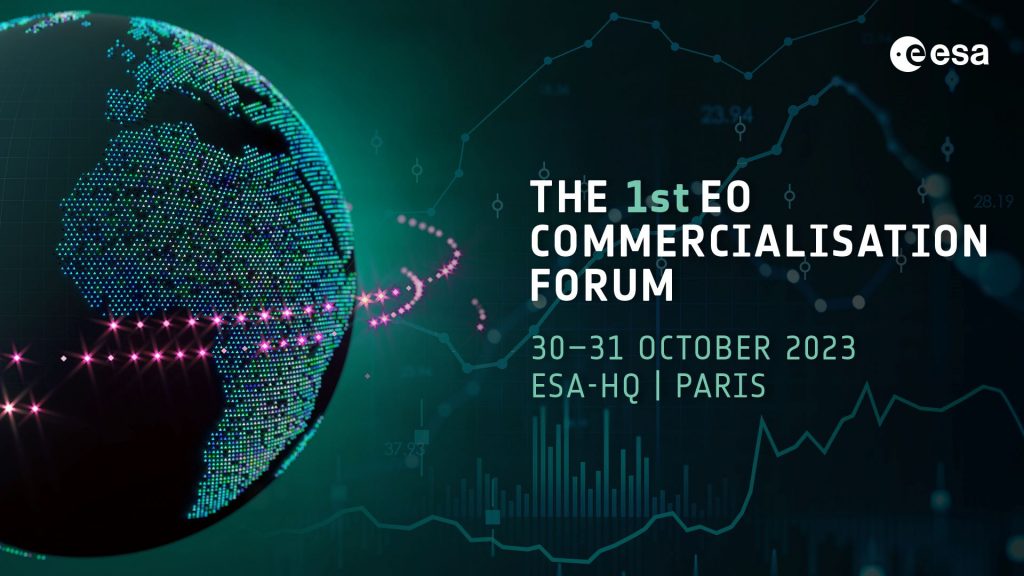
Registration is now open for ESA’s first-ever Earth Observation Commercialisation Forum. Taking place at ESA Headquarters in Paris from 30 to 31 October 2023, investors, institutions, entrepreneurs and companies of any size from the Earth observation sector will now be able to come together and discuss the commercial potential and challenges of Earth observation, together with the technical, industrial and risk-capital support available to European companies.

Advancing commercial space in Europe is a vital component of ESA Agenda 2025 and the Earth observation sector has an abundance of possibilities that private businesses can capitalise on, from satellites and ground infrastructure through to applications that solve real-world problems with data from space. ESA’s Earth Observation Programme Directorate is organising the first Earth Observation Commercialisation Forum to bring leading stakeholders of the fast-growing Earth observation commercial space sector under the same roof.

Read the full article on www.esa.int.

Additional commercialisation innovation opportunities for Portugal with InCubed

After confirming their support to ESA InCubed at the 2022 Ministerial Council, Portugal and ESA are announcing a new call for co-funding innovative Earth observation (EO) business cases.

With its mission to support commercially successful business activities in the Earth observation sector, the ESA InCubed programme has a fundamental role to play in promoting growth and competitiveness in the space economies of its Participating States. Portugal is a well-established subscriber to InCubed, and has recently confirmed its intention to open a new call for applying for InCubed co-funding.

Portuguese entities can now submit ideas, which will then be assessed by InCubed and the Portuguese Delegation. Activities selected will need to meet the needs of the Portuguese National Space Strategy, demonstrate a credible return on investment for the company and provide a balance of subject areas and geographical locations within Portugal.

Proposals can be submitted at any time, with two evaluation periods per year. In 2023, the first evaluation is scheduled for early July and the second for Quarter 4. Further details can be found on the Portuguese Space Agency website, and an online webinar to explain InCubed opportunities in Portugal will take place on 23 May at 11:00 CEST. Applicants for InCubed support from any participating state should submit their proposals on ideas.esa.int.

“This initiative from Portugal amply demonstrates the broad commitment to InCubed,” commented Head of the Φ-lab Invest Office Michele Castorina. “We will continue to work hand in hand with our participating states to increase access to finance for the European EO sector, and I look forward to seeing a host of new proposals from Portuguese enterprises.”

Carolina Sá is the Earth Observation officer at the Portuguese Space Agency: “Earth Observation and all its potentialities are a central component of Portugal’s National Strategy for Space. The Portuguese Space Agency believes that this funding opportunity for innovative products and services will give a fundamental boost to our national Earth Observation ecosystem.”

To Know more: ESA InCubed, Portuguese Space Agency

New call released for UK InCubed proposals

The latest ESA InCubed call for the United Kingdom is now out. UK entities are invited to submit proposals seeking to develop innovative and commercially viable products and services that exploit the value of Earth observation. The deadline for submissions is 31 May.

The ESA InCubed programme focuses on co-funding commercial development activities across the entire Earth observation (EO) value chain, including satellites, ground applications, downstream applications and new EO business models. InCubed works in very close cooperation with its participating Member States and periodically issues dedicated country-oriented calls.

The most recent national call has been released in collaboration with the UK Space Agency and is open to UK industry and academia. A total of £1 400 000 of funding has been made available, with no upper or lower limit for individual activities. Idea pitches and proposals will be jointly assessed by InCubed and the UK Space Agency, based on criteria such as financial return for the British space sector, level of innovation and wider environmental, social or economic benefits.

Selected activities must finish within 18 months of starting and be able to demonstrate market readiness at completion.

There will be a webinar on 24 April to guide entities on the application process and answer questions relating to the call. Requests to join the event can be sent by completing the online form.

Details of the call can be found here. Applicants should submit their proposals on ideas.esa.int, and the closing date for entries is 31 May 2023.

To Know more: ESA InCubed, UK Space Agency