
ESA title

Φ-lab Foundation Model Initiatives

Geospatial Foundation Models as a backbone for Earth Intelligence

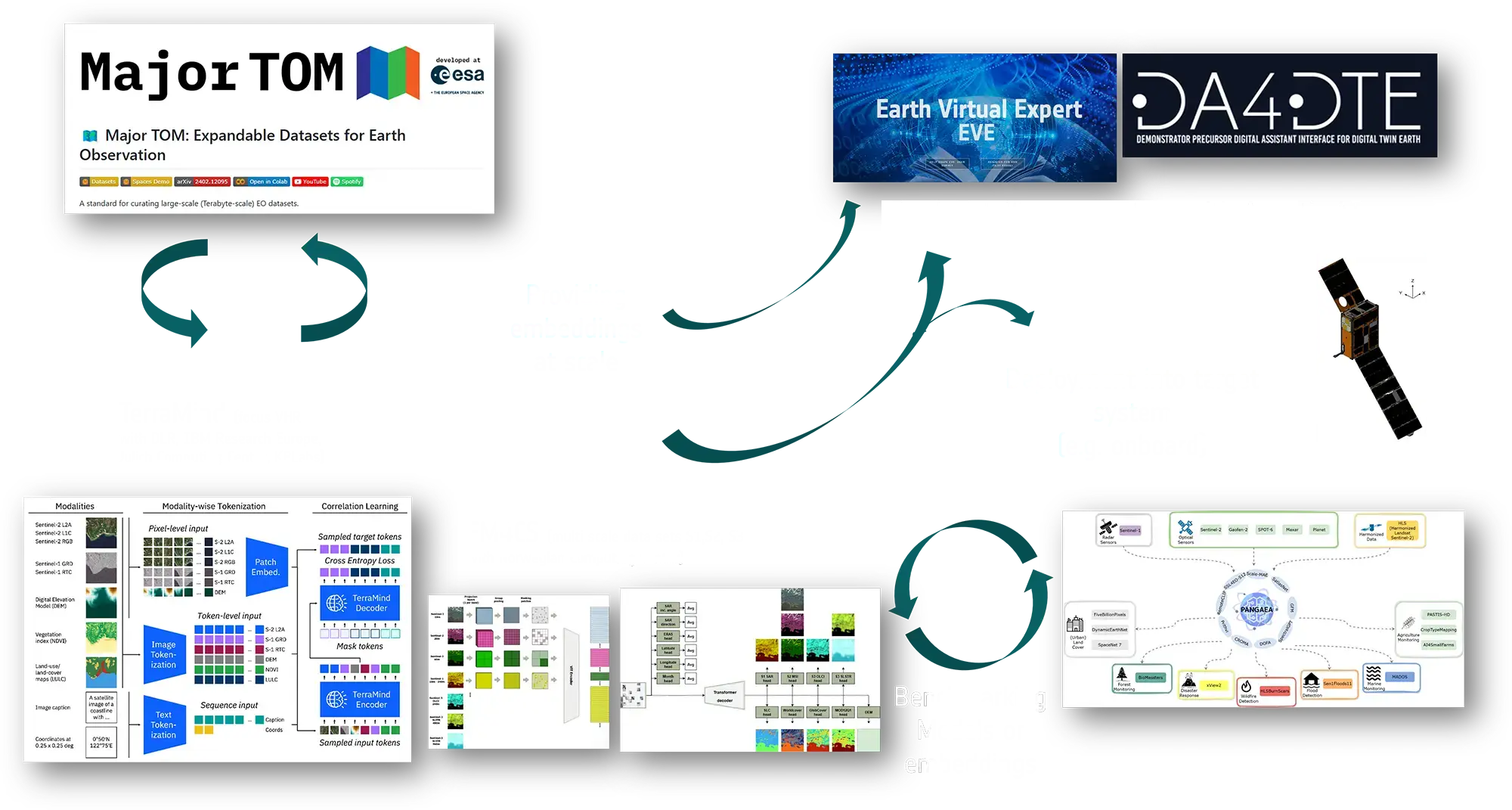
1. Data Creation and Preparation

Foundation models require large volumes of structured, diverse, and well‑prepared Earth Observation data. Φ-lab supports:

  • The collection and harmonisation of multisensor EO datasets;
  • The preparation of consistent data repositories for model training and evaluation;
  • The creation of semantically rich and temporally coherent datasets for downstream analytics.

These activities form the entry point of the EO GFM pipeline.

2. Foundation Model Development

Φ-lab leads the research and development of large EO models capable of understanding multimodal, spatial, spectral, and temporal information on a global scale.

These models aim to:

  • Encode multi‑mission EO knowledge into unified latent representations;
  • Support general geospatial reasoning tasks;
  • Integrate physical principles where relevant;
  • Use generative capabilities to synthesise new or missing EO modalities, while remaining grounded in physical constraints and sensor characteristics;
  • Define and evolve benchmarking and evaluation frameworks to assess semantic understanding, predictive skills, generative fidelity, physical consistency, robustness, and generalisation across sensors, regions, and time;

Our GFMs will evolve toward richer semantic understanding and incorporate predictive capabilities, enabling models to anticipate environmental dynamics and contribute to the development of a dynamic World Model.

With this trajectory, foundation models shift from passive perception systems toward proactive, semantically grounded, and predictive EO intelligence systems.

3. Embedding and Knowledge Representation

Once foundation models are trained, large‑scale embedding production transforms Earth Observation data into machine‑readable geospatial representations.

This phase includes:

  • Generation of spatial, spectral, and temporal embeddings;
  • Indexing and storage for fast retrieval;
  • Preparation of geospatial knowledge layers to be used by higher‑level reasoning systems;

Embeddings serve as the information backbone enabling semantic EO search, analysis, and automation..

4. Integration into Digital Assistants and AI Reasoning Systems

EO embeddings and foundation model outputs are integrated with advanced reasoning agents and language‑based digital assistants.

This integration enables:

  • Natural‑language interaction with EO and Earth Sciences knowledge, together with EO data analytics;
  • Semantic queries linked to geospatial representations;
  • Intelligent task automation grounded in EO knowledge;

The objective is to bridge human knowledge and expertise with deep, machine-level understanding of EO data, enabling collaborative human–AI systems where domain insight, scientific reasoning, and foundation model representations are tightly coupled.

5. Deployment on Specialised Hardware

Φ-lab advances the deployment of EO foundation models onto specialised hardware by focusing on model miniaturisation while preserving generalisation, robustness, and operational reliability.

This includes efforts to:

  • Reduce AI model size so that compact versions remain capable of broad generalisation;
  • Strengthen robustness against data drift and adversarial perturbations, relevant to onboard and edge environments;
  • Enable deployment on highly-constrained hardware for in‑orbit and edge processing;

These compact, yet capable models allow missions to become increasingly autonomous, versatile, and software‑defined, enabling satellites to:

  • Reconfigure onboard behavior through software updates;
  • Execute intelligent, context‑aware operations;
  • Deliver high performance despite strict resource constraints.

This direction supports the evolution toward AI‑empowered, software‑defined EO missions capable of adapting to new tasks and environmental conditions in real time.

Subscribe to our newsletter

Share