September 29, 2026
EOCognitiveLab Mission – Information Day
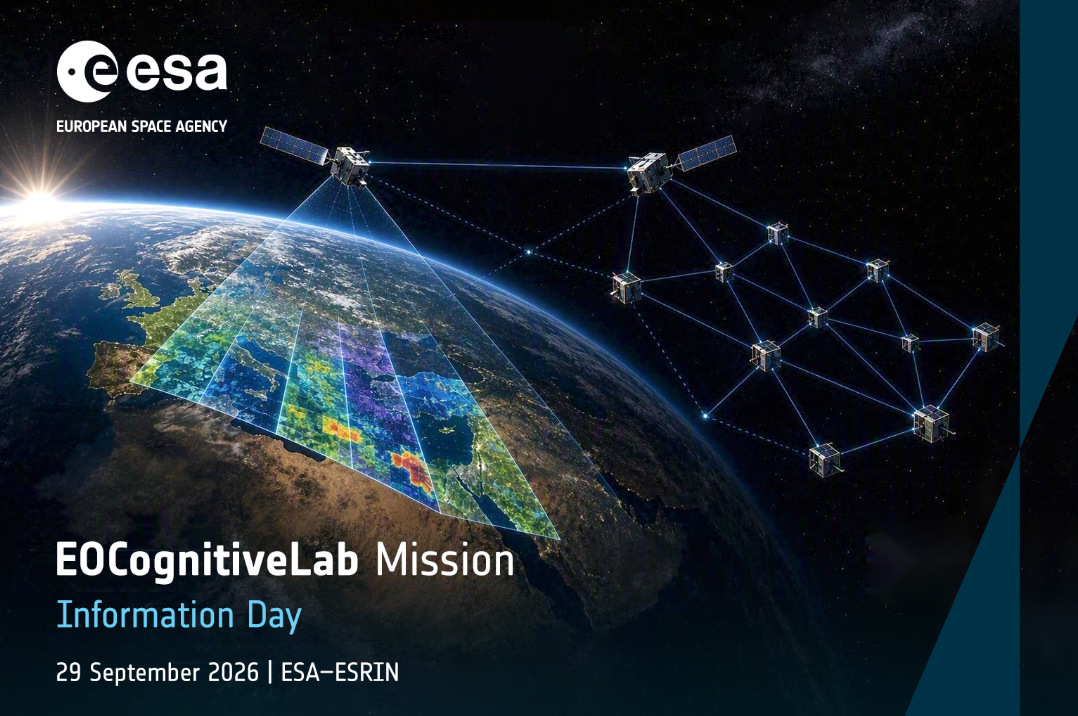


The European Space Agency has organised an information day in the context of the EOCognitiveLab Mission, an ESA open constellation experimentation mission.
Interested parties have now an opportunity to learn more about the initiative and upcoming opportunities.
Date: 29 September 2026
Location: ESA-ESRIN, Frascati, Italy
To participate, access the following link and download the information to register for the event: https://esastar-publication.sso.esa.int/news/details/11298
About ESA EOCognitiveLab:
EOCognitiveLab brings together the evolution of the Φsat mission series and ESA’s work on Computing in Space for Earth Observation (3CS4EO). The activity is intended to demonstrate the added values unlocked by AI-enabled, cooperative Earth observation capabilities across multiple heterogeneous satellites (including event-based acquisition replanning and coordinated acquisitions), onboard processing and intersatellite-link information exchange, for selected end-to-end Earth observation use cases, and to establish an in-orbit laboratory for autonomous, distributed and software-defined Earth observation missions.
EOCognitiveLab is an open constellation concept built around a core two-satellite segment that is expandable via federation of additional space and ground assets. The activity will define the EOCognitiveLab architecture and deliver the mission orchestration framework, while focusing on the design, implementation, launch, and commissioning of the core mission. Equipped with advanced onboard computing capabilities, open intersatellite-link interfaces and supported by ground processing infrastructure and an exploitation platform for data distribution, experimentation, and community access, the architecture is designed to enable the seamless integration and coordinated operation of additional federated assets as the ecosystem evolves. As an in-orbit laboratory, EOCognitiveLab will provide an open and expandable environment for additional in-orbit experimentation for ESA Members, Associated and Cooperating States, and the Earth observation community. Target experimentation areas include cooperative sensing, distributed processing, novel mission-orchestration approaches, onboard federated learning and fine-tuning, and other AI techniques relevant to distributed Earth observation systems.


